Advertisements
Advertisements
प्रश्न
The numerical ratio of displacement to distance for a moving object is :
पर्याय
always less than 1
equal to 1 or more than 1
always more than 1
equal to 1 or less than 1
Advertisements
उत्तर
equal to 1 or less than 1
i.e., Equal to 1 or less than 1.
Displacement is always smaller than or equal to displacement.
संबंधित प्रश्न
If the displacement of an object is proportional to the square of time, then the object is moving with :
Figure (a) shows the velocity-time graph for the motion of a body. Use it to find the displacement of the body at t = 1 s, 2 s, 3 s and 4 s, then draw on Figure (b), the displacement-time graph for it.
 |
 |
| (a) | (b) |
A car travels a distance 100 m with constant acceleration and average velocity of 20 ms-1. The final velocity acquired by the car is 25 ms-1.
Find
(i) The initial velocity.
(ii) Acceleration of the car.
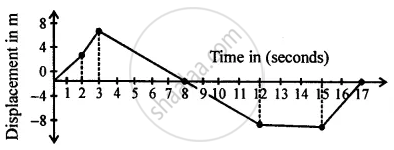
From the displacement – time graph shown given below calculate:
- Average velocity in the first three seconds.
- Displacement from the initial position at the end of 13 s.
- Time after which the body is at the initial position,
- Average velocity after 8 s.
Show the difference between distance and displacement with the help of a diagram.
A satellite makes a complete round along its circular orbit. What is its displacement?
A particle moves along a circular path. How many times does it change its direction in two complete rounds?
Which of the following is correct?
Give one example where the displacement is zero but the distance travelled is not zero.
Slope of a velocity-time graph gives
