Advertisements
Advertisements
प्रश्न
A motorbike running at 90 kmh−1, is slowed down to 54 kmh−1 by the application of brakes, over a distance of 40 m. If the brakes are applied with the same force, calculate
- total time in which bike comes to rest
- total distance travelled by bike.
Advertisements
उत्तर
Initial velocity = u = 90 kmh−1
= u = `90xx5/18` ms−1 = 25 ms−1
Final velocity = v = 54 kmh−1 = `54xx5/18` ms−1
v = 15 ms−1
Distance = S = 40 m
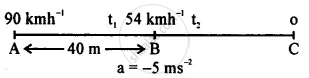
v2 = u2 + 2as
(15)2 = (25)2 + 2 ⋅ a ⋅ 40 ⇒ 225 = 625 + 80a ⇒ 80a = 225 − 625 = −400 ⇒ a = `(-400)/80`
a = −5 m/s2
v = u + at ⇒ 0 = 25 + (−5)t ⇒ t = `25/5` = 5 seconds
v2 = u2 + 2as ⇒ 0 = (25) 2 + 2 ⋅ (−5) ⋅ s ⇒ 625 = 10s ⇒ s = `625/10` = 62.5 m
Total time to stop = 5 seconds
Total distance before stopping = 62.5 m
APPEARS IN
संबंधित प्रश्न
What can you say about the nature of motion of a body if its displacement-time graph is A straight line parallel to the time axis?
A body is moving in a straight line and its displacement at various instants of time is given in the following table
| Time (s) | 0 | 1 | 2 | 3 | 4 | 5 | 6 | 7 |
| Displacement (m) | 2 | 6 | 12 | 12 | 12 | 18 | 22 | 24 |
Plot the displacement-time graph and calculate
(i) Total distance travelled in the interval 1 s to 5 s.
(ii) Average velocity in time interval 1 s to 5 s.
Figure given below shows a velocity-time graph for a car starting from rest. The graph has three parts AB, BC and CD.
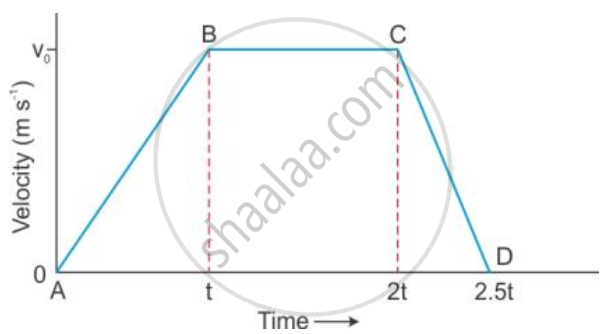
Compare the distance travelled in part BC with the distance travelled in part AB.
Give an example of a body which covers a certain distance, but its displacement is zero.
A car travels at a uniform speed of 42 km/h. In 10 minutes, how much distance would it cover?
The figure represents graphically the velocity of a car moving along a straight road over a period of 100 hours.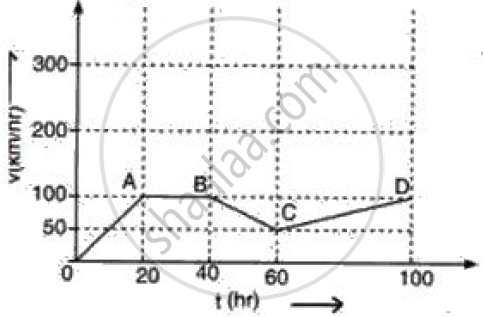
Calculate the distance travelled in the last 40 h.
The table below shows the distance travelled by two vehicles A and B during each second:
| Time (s) | 0 | 1 | 2 | 3 | 4 | 5 | 6 | 7 |
| Distance travelled by A (m) | 0 | 20 | 80 | 180 | 240 | 300 | 360 | 420 |
| Distance travelled by B (m) | 0 | 10 | 40 | 90 | 160 | 250 | 360 | 490 |
At what time do A and B meet?Which vehicle is moving with a constant acceleration?
Exercise Problems.
An athlete completes one round of a circular track of diameter 200 m in 40 s. What will be the distance covered and the displacement at the end of 2 m and 20 s?
A body moves is a circle of radius ‘2R’ what is the distance covered and displacement of the body after 2 complete rounds?
Using the following data, draw time - displacement graph for a moving object:
| Time (s) | 0 | 2 | 4 | 6 | 8 | 10 | 12 | 14 | 16 |
| Displacement (m) | 0 | 2 | 4 | 4 | 4 | 6 | 4 | 2 | 0 |
Use this graph to find average velocity for the first 4 s, for the next 4 s and for the last 6 s.
