Advertisements
Advertisements
प्रश्न
Ashok starts from his house and travels 3 km to reach his school. On finding the school gates closed, he returns to his house. What is?
The displacement of Ashok
Advertisements
उत्तर

Displacement is =O as starting and ending point are coinciding.
APPEARS IN
संबंधित प्रश्न
The following table gives the displacement of a car at different instants of time.
| Time (s) | 0 | 1 | 2 | 3 | 4 |
| Displacement (m) | 0 | 5 | 10 | 15 | 20 |
- Draw the displacement-time sketch and find the average velocity of the car.
- What will be the displacement of the car at (i) 2.5 s and (ii) 4.5 s?
Write an expression for the distance S covered in time t by a body which is initially at rest and starts moving with a constant acceleration a.
When brakes are applied to a bus, retardation produced is 25 cm s-2 and the bus takes 20 s to stop. Calculate -
- The initial velocity of the bus
- The distance travelled by bus during this time.
Give an example of a body which covers a certain distance, but its displacement is zero.
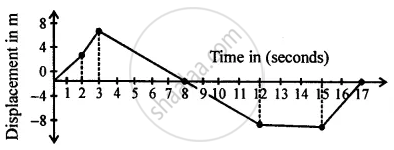
From the displacement – time graph shown given below calculate:
- Average velocity in the first three seconds.
- Displacement from the initial position at the end of 13 s.
- Time after which the body is at the initial position,
- Average velocity after 8 s.
Calculate the distance and displacement in the following case: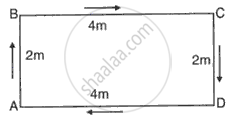
A satellite makes a complete round along its circular orbit. What is its displacement?
A body moves along a circular path of radius r. When it completes three complete rounds, what is the ratio of distance covered to its displacement?
State whether true or false. If false, correct the statement.
Distance covered by a particle never becomes zero but displacement becomes zero.
A body is projected up with an initial velocity of u m/s. It goes up to a height, ‘h’ meters in seconds' time. Then it comes back at the point of projection.
Considering negligible air resistance, which of the following statement is true?
