Advertisements
Advertisements
प्रश्न
When brakes are applied to a bus, retardation produced is 25 cm s-2 and the bus takes 20 s to stop. Calculate -
- The initial velocity of the bus
- The distance travelled by bus during this time.
Advertisements
उत्तर
Final velocity (v) = 0
retardation = -25 cm/s2
Expressing it in m s-2
25 cm s-2 = `25/100` m s-2
Hence, - a = - 0.25 m s-2
Time taken (t)= 20 s
(i) Let 'u' be the initial velocity.
Using the first equation of motion,
v = u + at
We get,
u = v - at
u = 0 - (- 0.25)(20)
u = 5 m s-1
(ii) Let 's' be the distance travelled.
Using the third equation of motion,
v2 - u2 = 2as
We get,
∴ (0) 2 - (5)2 = 2 (-0.25) (s)
∴ 0 - 25 = - 0.5 × s
∴ - 25 = - 0.5 s
∴ `(- 25)/(- 0.5)` = s
∴ s = 50 m.
APPEARS IN
संबंधित प्रश्न
What can you say about the nature of motion of a body if its displacement-time graph is A curve.
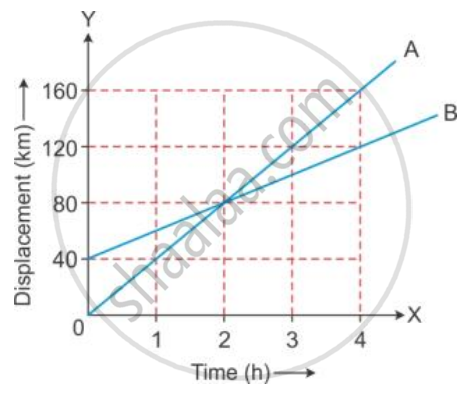
Figure ahead represents the displacement - time sketch of motion of two cars A and B . Find :
(i) the distance by which the car B was initially ahead of car A.
(ii) the velocities of car A and car B.
(iii) the time in which car A catches car B.
(iv) the distance from start when the car A will catch the car B.
Explain the following concept in your own words with everyday examples:
Distance
Can you suggest the kind of motion of a body from the following distance – time graph?
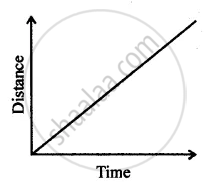
Can you suggest the kind of motion of a body from the following distance – time graph?
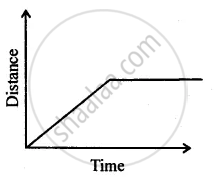
A motorbike running at 90 kmh−1, is slowed down to 54 kmh−1 by the application of brakes, over a distance of 40 m. If the brakes are applied with the same force, calculate
- total time in which bike comes to rest
- total distance travelled by bike.
Can distance covered by a body be less than the magnitude of its displacement?
An object is thrown vertically upwards. It rises upto a height H and then returns to its initial position. Calculate
The displacement of the object.
Displacement / Time : Velocity :: Speed / Time : ______.
A car starts from rest and moves along the x-axis with constant acceleration 5 ms–2 for 8 seconds. If it then continues with constant velocity, what distance will the car cover in 12 seconds since it started from the rest?
