Advertisements
Advertisements
प्रश्न
Clarify the difference.
Distance and displacement
Advertisements
उत्तर
| Distance | Displacement |
| It is defined as the length of the actual path travelled by an object in motion. | It is defined as the shortest distance between the starting and finishing points. |
| It is a scalar quantity. | It is a vector quantity. |
| The values of distance are always positive. | The values of displacement can be positive, negative or zero. |
APPEARS IN
संबंधित प्रश्न
An ant travels a distance of 8 cm from P to Q and then moves a distance of 6 cm at right angles to PQ. Find its resultant displacement.
When is the magnitude of displacement equal to the distance?
State how the velocity-time graph can be used to find The distance travelled by the body in a given time
Figure shows the displacement-time graph of two vehicles A and B moving along a straight road. Which vehicle is moving faster? Give reason.
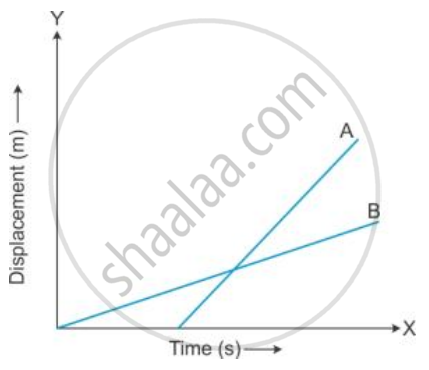
How is the distance related with time for motion under uniform acceleration such as the motion of a freely falling body?
Figure ahead represents the displacement - time sketch of motion of two cars A and B . Find :
(i) the distance by which the car B was initially ahead of car A.
(ii) the velocities of car A and car B.
(iii) the time in which car A catches car B.
(iv) the distance from start when the car A will catch the car B.
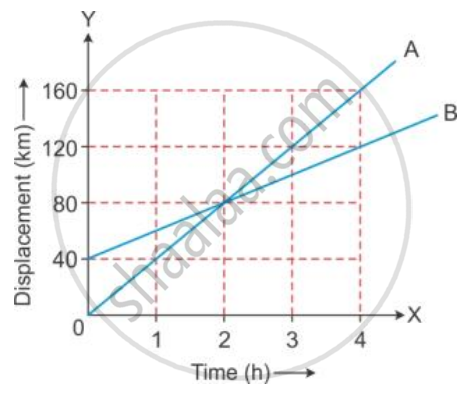
Figure given below shows a velocity-time graph for a car starting from rest. The graph has three parts AB, BC and CD.
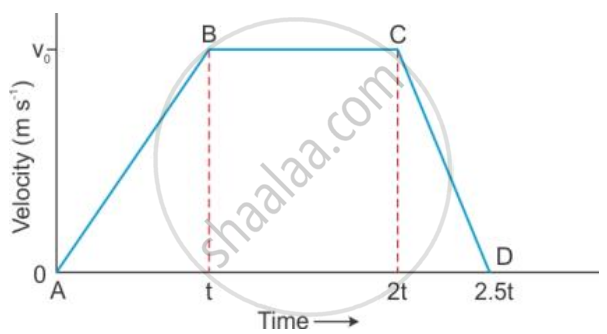
State how is the distance travelled in any part determined from this graph .
Define Displacement.
Give an example of a body which covers a certain distance, but its displacement is zero.
A racehorse runs straight towards the north and covers 540 m in one minute. Calculate
- displacement of the horse,
- its velocity in (a) ms−1 (b) kmh−1.
How can you find the following?
Displacement from velocity – time graph.
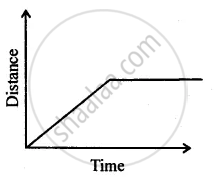
Can you suggest the kind of motion of a body from the following distance – time graph?
Ashok starts from his house and travels 3 km to reach his school. On finding the school gates closed, he returns to his house. What is?
The displacement of Ashok
Is distance covered during nth second more than the distance covered in n seconds?
The table below shows the distance travelled by two vehicles A and B during each second:
| Time (s) | 0 | 1 | 2 | 3 | 4 | 5 | 6 | 7 |
| Distance travelled by A (m) | 0 | 20 | 80 | 180 | 240 | 300 | 360 | 420 |
| Distance travelled by B (m) | 0 | 10 | 40 | 90 | 160 | 250 | 360 | 490 |
At what time do A and B meet?Which vehicle is moving with a constant acceleration?
Fill in the boxes.
| S.No | First Move | Seconde Move | Distance (m) | Displacement |
| 1. | Move 4 metres east | Move 2 metres west | 6 | 2 m east |
| 2. | Move 4 metres north | Move 2 metres south | ||
| 3. | Move 2 metres east | Move 4 metres west | ||
| 4. | Move 5 metres east | Move 5 metres west | ||
| 5. | Move 5 metres south | Move 2 metres north | ||
| 6. | Move 10 metres west | Move 3 metres east |
Give one example where the displacement is zero but the distance travelled is not zero.
The displacement covered by the second hand of radius V in a clock after one revolution is ______.
