Advertisements
Advertisements
प्रश्न
Fill in the boxes.
| S.No | First Move | Seconde Move | Distance (m) | Displacement |
| 1. | Move 4 metres east | Move 2 metres west | 6 | 2 m east |
| 2. | Move 4 metres north | Move 2 metres south | ||
| 3. | Move 2 metres east | Move 4 metres west | ||
| 4. | Move 5 metres east | Move 5 metres west | ||
| 5. | Move 5 metres south | Move 2 metres north | ||
| 6. | Move 10 metres west | Move 3 metres east |
Advertisements
उत्तर
| S.No | First Move | Seconde Move | Distance (m) | Displacement |
| 1. | Move 4 metres east | Move 2 metres west | 6 m | 2 m east |
| 2. | Move 4 metres north | Move 2 metres south | 6 m | 2 m north |
| 3. | Move 2 metres east | Move 4 metres west | 6 m | 2 m west |
| 4. | Move 5 metres east | Move 5 metres west | 10 m | 0 (same place) |
| 5. | Move 5 metres south | Move 2 metres north | 7 m | 3 m south |
| 6. | Move 10 metres west | Move 3 metres east | 13 m | 7 m west |
APPEARS IN
संबंधित प्रश्न
An athlete completes one round of a circular track of diameter 200 m in 40 s. What will be the distance covered and the displacement at the end of 2 minutes 20 s?
What can you say about the nature of motion of a body if its displacement-time graph is A straight line parallel to the time axis?
How is the distance related with time for motion under uniform acceleration such as the motion of a freely falling body?
Give an example of a body which covers a certain distance, but its displacement is zero.
How can you find the following?
Displacement from velocity – time graph.
A motor car slows down from 72 kmh−1 to 36 kmh−1 over a distance of 25 m. If the brakes are applied with the same force
calculate
- total time in which car comes to rest
- distance travelled by it.
Calculate the distance and displacement in the following case: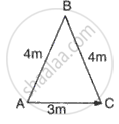
A satellite makes a complete round along its circular orbit. What is its displacement?
The figure represents graphically the velocity of a car moving along a straight road over a period of 100 hours.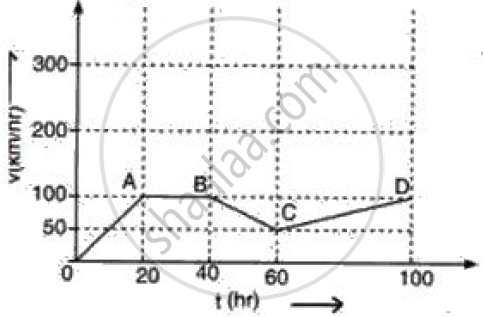
Calculate the distance travelled in the last 40 h.
The table below shows the distance travelled by two vehicles A and B during each second:
| Time (s) | 0 | 1 | 2 | 3 | 4 | 5 | 6 | 7 |
| Distance travelled by A (m) | 0 | 20 | 80 | 180 | 240 | 300 | 360 | 420 |
| Distance travelled by B (m) | 0 | 10 | 40 | 90 | 160 | 250 | 360 | 490 |
Which vehicle is moving with a constant acceleration?
