Advertisements
Advertisements
प्रश्न
Fill in the boxes.
| S.No | First Move | Seconde Move | Distance (m) | Displacement |
| 1. | Move 4 metres east | Move 2 metres west | 6 | 2 m east |
| 2. | Move 4 metres north | Move 2 metres south | ||
| 3. | Move 2 metres east | Move 4 metres west | ||
| 4. | Move 5 metres east | Move 5 metres west | ||
| 5. | Move 5 metres south | Move 2 metres north | ||
| 6. | Move 10 metres west | Move 3 metres east |
Advertisements
उत्तर
| S.No | First Move | Seconde Move | Distance (m) | Displacement |
| 1. | Move 4 metres east | Move 2 metres west | 6 m | 2 m east |
| 2. | Move 4 metres north | Move 2 metres south | 6 m | 2 m north |
| 3. | Move 2 metres east | Move 4 metres west | 6 m | 2 m west |
| 4. | Move 5 metres east | Move 5 metres west | 10 m | 0 (same place) |
| 5. | Move 5 metres south | Move 2 metres north | 7 m | 3 m south |
| 6. | Move 10 metres west | Move 3 metres east | 13 m | 7 m west |
APPEARS IN
संबंधित प्रश्न
Can displacement be zero even if the distance is not zero? Give one example to explain your answer.
A body when projected up with an initial velocity u goes to a maximum height h in time t and then comes back at the point of projection. The correct statement is ______________
Figure ahead represents the displacement - time sketch of motion of two cars A and B . Find :
(i) the distance by which the car B was initially ahead of car A.
(ii) the velocities of car A and car B.
(iii) the time in which car A catches car B.
(iv) the distance from start when the car A will catch the car B.
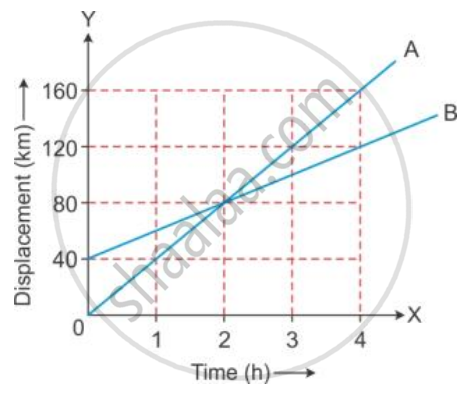
Figure given below shows a velocity-time graph for a car starting from rest. The graph has three parts AB, BC and CD.
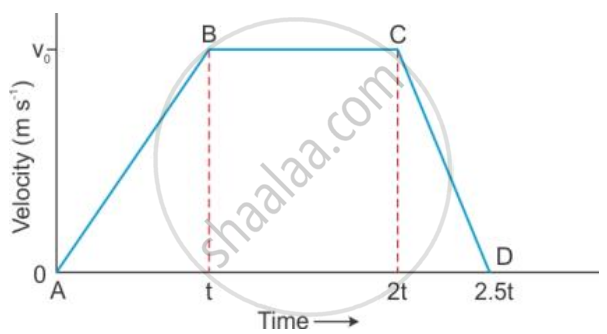
State how is the distance travelled in any part determined from this graph .
Explain the following concept in your own words with everyday examples:
Distance
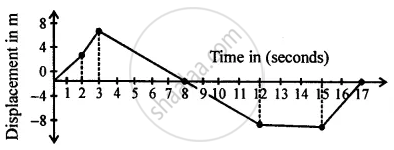
From the displacement – time graph shown given below calculate:
- Average velocity in the first three seconds.
- Displacement from the initial position at the end of 13 s.
- Time after which the body is at the initial position,
- Average velocity after 8 s.
A body is moving along a circular path of radius r. What will be the distance and displacement of the body when it completes:
`(3/4)` th of a revolution
A particle moves along a circular path. How many times does it change its direction in two complete rounds?
Displacement / Time : Velocity :: Speed / Time : ______.
Distinguish distance and displacement.
