Advertisements
Advertisements
प्रश्न
A body travels a distance of 3 km towards East, then 4 km towards North and finally 9 km towards East.
What is the resultant displacement ?
Advertisements
उत्तर
The body travels a total distance of 12 km east, which means towards the x-axis, on a Cartesian plane. It travels a distance of 4 km in north direction, which means towards y-axis.
Resultant displacement :
`sqrt(12^2+4^2)`
= `sqrt(144 + 16)`
= `sqrt(160)`
= 12.65 km
APPEARS IN
संबंधित प्रश्न
If on a round trip you travel 6 km and then arrive back home :
What distance have you travelled ?
Clarify the difference.
Distance and displacement
What can you say about the nature of motion of a body if its displacement-time graph is A curve.
Figure shows the velocity-time graph of a particle moving in a straight line.
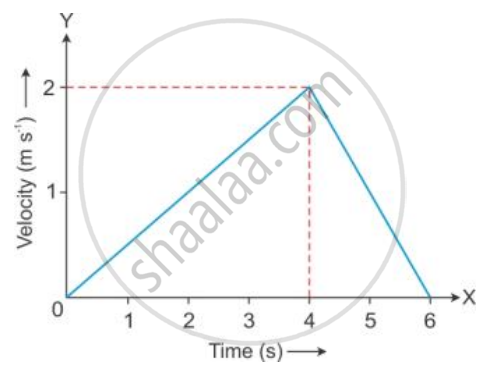
(i) State the nature of motion of particle.
(ii) Find the displacement of particle at t = 6 s.
(iii) Does the particle change its direction of motion?
(iv) Compare the distance travelled by the particle from 0 to 4 s and from 4 s to 6 s.
(v) Find the acceleration from 0 to 4 s and retardation from 4 s to 6 s.
Explain the following concept in your own words with everyday examples:
Distance
Write two differences between distance and displacement.
Is distance covered during nth second more than the distance covered in n seconds?
The table below shows the distance travelled by two vehicles A and B during each second:
| Time (s) | 0 | 1 | 2 | 3 | 4 | 5 | 6 | 7 |
| Distance travelled by A (m) | 0 | 20 | 80 | 180 | 240 | 300 | 360 | 420 |
| Distance travelled by B (m) | 0 | 10 | 40 | 90 | 160 | 250 | 360 | 490 |
Give the value of the velocity at which they are meeting
In which of the following cases of motions, the distance moved and the magnitude of displacement are equal?
Using the following data, draw time - displacement graph for a moving object:
| Time (s) | 0 | 2 | 4 | 6 | 8 | 10 | 12 | 14 | 16 |
| Displacement (m) | 0 | 2 | 4 | 4 | 4 | 6 | 4 | 2 | 0 |
Use this graph to find average velocity for the first 4 s, for the next 4 s and for the last 6 s.
