Advertisements
Advertisements
प्रश्न
A car travels a distance 100 m with constant acceleration and average velocity of 20 ms-1. The final velocity acquired by the car is 25 ms-1.
Find
(i) The initial velocity.
(ii) Acceleration of the car.
Advertisements
उत्तर
Distance travelled s = 100 m
Average velocity V = 20 m/s
Final velocity v = 25 m/s
(i) Let u be the initial velocity.
Average velocity = (Initial velocity + Final velocity)/2
V = (u + v)/2
20 = (u + 25)/2
u = 40 - 25 = 15 m/s-1
(ii) Let 'a' be the acceleration of the car.
Using the third equation of motion,
v2 - u2 = 2as
We get,
(25) 2 - (15) 2 = 2 (a) (100)
625 - 225 = 200 a
a = (400/200) m/s2 = 2 m/s-2
APPEARS IN
संबंधित प्रश्न
A body when projected up with an initial velocity u goes to a maximum height h in time t and then comes back at the point of projection. The correct statement is ______________
Figure shows the velocity-time graph of a particle moving in a straight line.
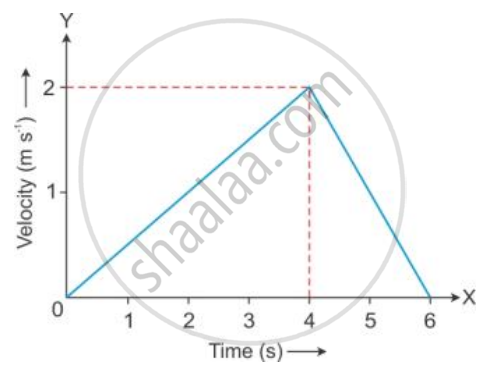
(i) State the nature of motion of particle.
(ii) Find the displacement of particle at t = 6 s.
(iii) Does the particle change its direction of motion?
(iv) Compare the distance travelled by the particle from 0 to 4 s and from 4 s to 6 s.
(v) Find the acceleration from 0 to 4 s and retardation from 4 s to 6 s.
Give two differences between displacement and distance.
A racehorse runs straight towards the north and covers 540 m in one minute. Calculate
- displacement of the horse,
- its velocity in (a) ms−1 (b) kmh−1.
Draw displacement – time graph for the following situation:
When a body is moving with variable velocity.
Show the difference between distance and displacement with the help of a diagram.
A body is moving along a circular path of radius r. What will be the distance and displacement of the body when it completes:
Half a revolution
A particle moves along a circular path. How many times does it change its direction in two complete rounds?
The graph shows how the velocity of a scooter varies with time in 50 s.
Work out: The distance traveled in 10 s, 20 s, and 50 s.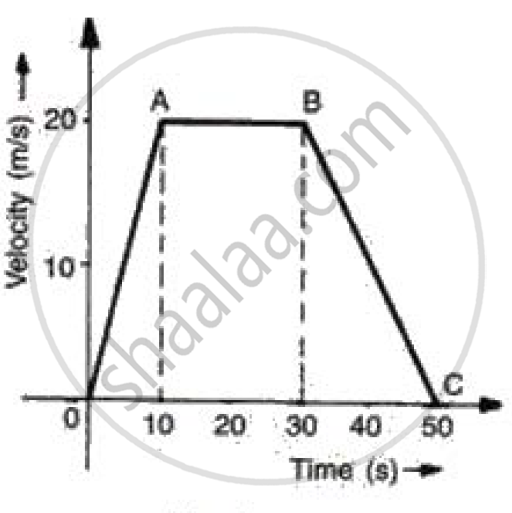
Using the following data, draw time - displacement graph for a moving object:
| Time (s) | 0 | 2 | 4 | 6 | 8 | 10 | 12 | 14 | 16 |
| Displacement (m) | 0 | 2 | 4 | 4 | 4 | 6 | 4 | 2 | 0 |
Use this graph to find average velocity for the first 4 s, for the next 4 s and for the last 6 s.
