Advertisements
Advertisements
प्रश्न
When brakes are applied to a bus, retardation produced is 25 cm s-2 and the bus takes 20 s to stop. Calculate -
- The initial velocity of the bus
- The distance travelled by bus during this time.
Advertisements
उत्तर
Final velocity (v) = 0
retardation = -25 cm/s2
Expressing it in m s-2
25 cm s-2 = `25/100` m s-2
Hence, - a = - 0.25 m s-2
Time taken (t)= 20 s
(i) Let 'u' be the initial velocity.
Using the first equation of motion,
v = u + at
We get,
u = v - at
u = 0 - (- 0.25)(20)
u = 5 m s-1
(ii) Let 's' be the distance travelled.
Using the third equation of motion,
v2 - u2 = 2as
We get,
∴ (0) 2 - (5)2 = 2 (-0.25) (s)
∴ 0 - 25 = - 0.5 × s
∴ - 25 = - 0.5 s
∴ `(- 25)/(- 0.5)` = s
∴ s = 50 m.
APPEARS IN
संबंधित प्रश्न
State whether distance is a scalar or a vector quantity.
If on a round trip you travel 6 km and then arrive back home :
What distance have you travelled ?
A body travels a distance of 3 km towards East, then 4 km towards North and finally 9 km towards East.
What is the resultant displacement ?
Figure given below shows a velocity-time graph for a car starting from rest. The graph has three parts AB, BC and CD.
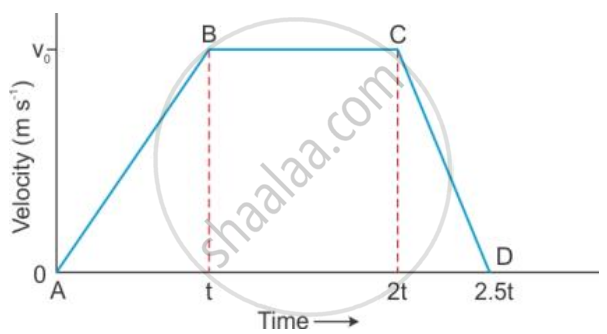
State how is the distance travelled in any part determined from this graph .
A body starts with an initial velocity of 10m s-1 and acceleration 5 m s-2. Find the distance covered by it in 5 s.
A car travels a distance 100 m with constant acceleration and average velocity of 20 ms-1. The final velocity acquired by the car is 25 ms-1.
Find
(i) The initial velocity.
(ii) Acceleration of the car.
A car covers 90 km in `1 1/2` hours towards east. Calculate
- displacement of car,
- its velocity in (a) kmh−1 (b) ms−1.
The table below shows the distance travelled by two vehicles A and B during each second:
| Time (s) | 0 | 1 | 2 | 3 | 4 | 5 | 6 | 7 |
| Distance travelled by A (m) | 0 | 20 | 80 | 180 | 240 | 300 | 360 | 420 |
| Distance travelled by B (m) | 0 | 10 | 40 | 90 | 160 | 250 | 360 | 490 |
Which vehicle is moving with a constant acceleration?
The table below shows the distance travelled by two vehicles A and B during each second:
| Time (s) | 0 | 1 | 2 | 3 | 4 | 5 | 6 | 7 |
| Distance travelled by A (m) | 0 | 20 | 80 | 180 | 240 | 300 | 360 | 420 |
| Distance travelled by B (m) | 0 | 10 | 40 | 90 | 160 | 250 | 360 | 490 |
Give the value of the velocity at which they are meeting
An object is dropped from rest at a height of 150 m and simultaneously another object is dropped from rest at a height of 100 m. What is the difference in their heights after 2s if both the objects drop with the same accelerations? How does the difference in heights vary with time?
