Advertisements
Advertisements
प्रश्न
The figure represents graphically the velocity of a car moving along a straight road over a period of 100 hours.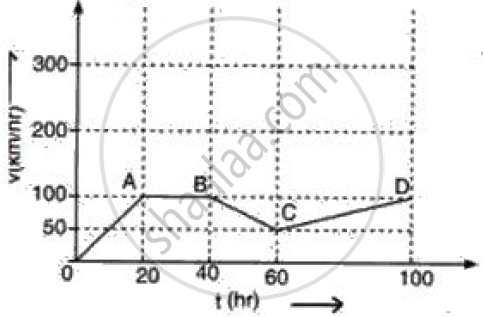
Calculate the distance travelled in the last 40 h.
Advertisements
उत्तर
Distance travelled in last 40 hour would be equal to area under graph during that time = 50 x (100 - 60) + `1/2`x(100 - 60) x(100 - 50).
S = 2000 + 1000 = 3000 km.
APPEARS IN
संबंधित प्रश्न
A particle is moving in a circular path of radius r. The displacement after half a circle would be :
State how the velocity-time graph can be used to find The displacement of the body in a given time.
Figure (a) shows the velocity-time graph for the motion of a body. Use it to find the displacement of the body at t = 1 s, 2 s, 3 s and 4 s, then draw on Figure (b), the displacement-time graph for it.
 |
 |
| (a) | (b) |
Figure shows the velocity-time graph of a particle moving in a straight line.
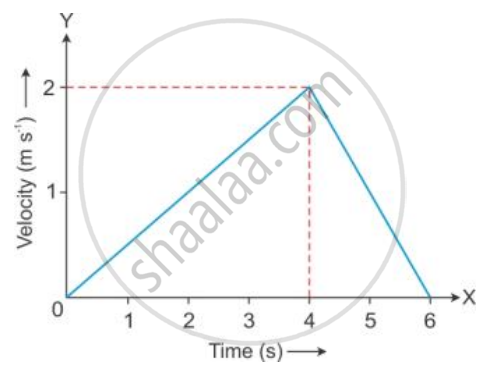
(i) State the nature of motion of particle.
(ii) Find the displacement of particle at t = 6 s.
(iii) Does the particle change its direction of motion?
(iv) Compare the distance travelled by the particle from 0 to 4 s and from 4 s to 6 s.
(v) Find the acceleration from 0 to 4 s and retardation from 4 s to 6 s.
Draw displacement – time graph for the following situation:
When a body is moving with uniform velocity.
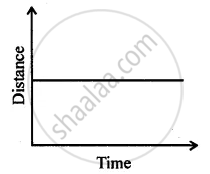
Can you suggest the kind of motion of a body from the following distance – time graph?
A body moves is a circle of radius ‘2R’ what is the distance covered and displacement of the body after 2 complete rounds?
A car starts from rest and moves along the x-axis with constant acceleration 5 ms–2 for 8 seconds. If it then continues with constant velocity, what distance will the car cover in 12 seconds since it started from the rest?
An object is dropped from rest at a height of 150 m and simultaneously another object is dropped from rest at a height of 100 m. What is the difference in their heights after 2s if both the objects drop with the same accelerations? How does the difference in heights vary with time?
A particle is moving in a circular pattern of radius r. The displacement after half a circle would be ______.
