Advertisements
Advertisements
प्रश्न
Figure represents graphically the velocity of a car moving along a straight road over a period of 100 hours.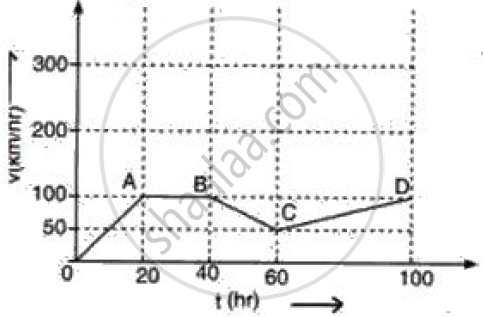
Calculate the acceleration along AB and the retardation along BC.
Advertisements
उत्तर
Acceleration along AB= (100 - 100)/(40 -20) = 0 ms-2
Retardation along CD= (100 - 50)/ (100 - 60) = 50/40 = 1.25 ms-2
APPEARS IN
संबंधित प्रश्न
Give a scientific reason.
When an object falls freely to the ground, its acceleration is uniform.
The unit of retardation is ____________
A car travels with uniform velocity of 25 m s-1 for 5 s. The brakes are then applied and the car is uniformly retarded and comes to rest in further 10 s. Find:
- The distance which the car travels before the brakes are applied,
- Retardation and
- The distance travelled by car after applying the brakes.
Write the SI unit of retardation.
Write the SI unit of acceleration and retardation.
The speed of a car increases from 10 km/h to 64 km/h in 10 seconds. What will be its acceleration?
A car accelerates to a velocity of 30 m/s in 10 s and then decelerates for 20 s so that it stops. Draw a velocity-time graph to represent the motion and find:
The Deceleration.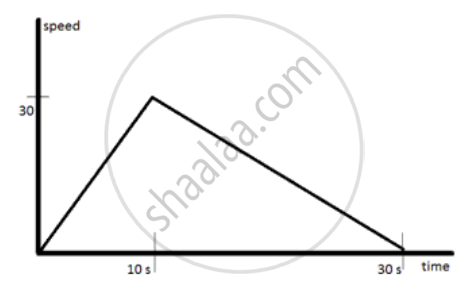
What do you mean by constant acceleration?
State whether true or false. If false, correct the statement.
Acceleration can get negative value also.
Assertion: When a body is subjected to a uniform acceleration, it is always moving in a straight line.
Reason: Motion may be straight-line motion or circular motion.
