Advertisements
Advertisements
प्रश्न
Figure given below shows a velocity-time graph for a car starting from rest. The graph has three parts AB, BC and CD.
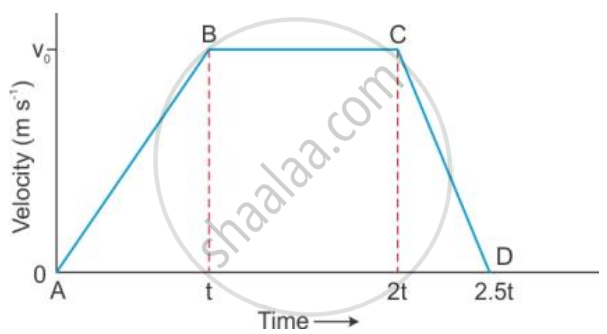
Which part of graph shows motion with uniform
(a) velocity (b) acceleration (c) retardation ?
Advertisements
उत्तर
(a) BC shows motion with uniform velocity.
(b) AB shows motion with uniform acceleration.
(c) CD shows motion with uniform retardation.
APPEARS IN
संबंधित प्रश्न
A body is moving vertically upwards. Its velocity changes at a constant rate from 50 m s−1 to 20 m s−1 in 3 s. What is its acceleration?
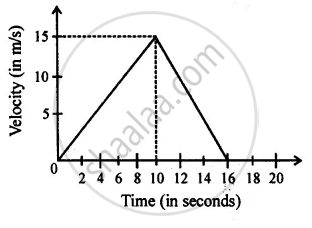
From the diagram given below, calculate deceleration.
What is the SI unit of acceleration?
Distinguish between uniformly and non-uniformly accelerated motions.
The initial velocity of a car is 10 ms-1. It moves with an acceleration of 2 ms-2. What will be its speed after 10 seconds?
State if the following situation is possible:
A body moving with a constant velocity in an accelerated motion.
The graph shows how the velocity of a scooter varies with time in 50 s.
Work out: Deceleration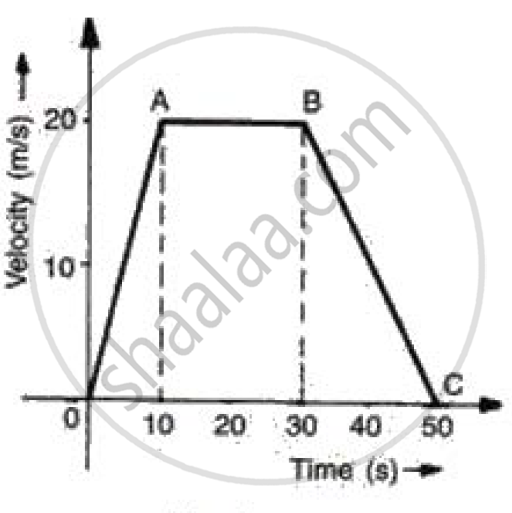
A car starts from rest and it is travelling with a velocity of 20 m/s in 10 s. What is its acceleration?
m/s2 is the unit of ______.
An object can be moving with uniform speed but with variable acceleration.
