Advertisements
Advertisements
प्रश्न
Figure given below shows a velocity-time graph for a car starting from rest. The graph has three parts AB, BC and CD.
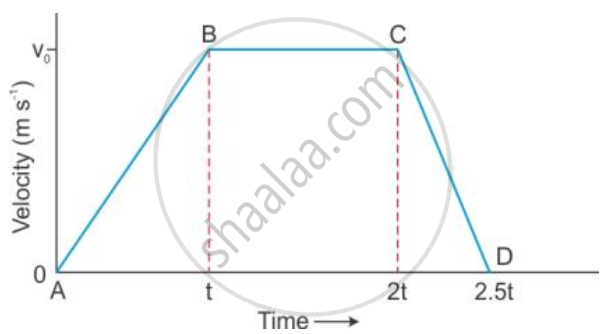
Compare the distance travelled in part BC with the distance travelled in part AB.
Advertisements
उत्तर
Distance travelled in part BC = Area of the rectangle tBC2t = base × height.
= (2t - t) × vo
= vot
Distance travelled in part AB = Area of the triangle ABt
= (1/2) × base × height
= (1/2) × t × vo
= (1/2) vo t
Therefore, distance travelled in part BC:distance travelled in part AB :: 2:1.
APPEARS IN
संबंधित प्रश्न
A body is moving along a circular path of radius R. What will be the distance travelled and displacement of the body when it completes half a revolution ?
If on a round trip you travel 6 km and then arrive back home :
What is your final displacement ?
What information about the motion of a body are obtained from the displacement-time graph?
Figure given below shows a velocity-time graph for a car starting from rest. The graph has three parts AB, BC and CD.
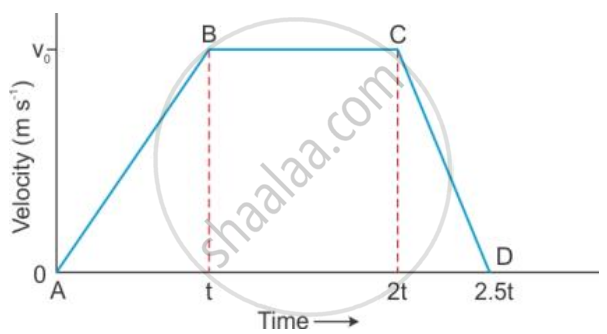
State how is the distance travelled in any part determined from this graph .
Define Distance.
How can you find the following?
Velocity from a displacement – time graph.
A motor car slows down from 72 kmh−1 to 36 kmh−1 over a distance of 25 m. If the brakes are applied with the same force
calculate
- total time in which car comes to rest
- distance travelled by it.
An object is thrown vertically upwards. It rises upto a height H and then returns to its initial position. Calculate
The displacement of the object.
Geetha takes 15 minutes from her house to reach her school on a bicycle. If the bicycle has a speed of 2 m/s, calculate the distance between her house and the school.
Distance is a ______ quantity.
