Advertisements
Advertisements
प्रश्न
The initial velocity of a car is 10 ms-1. It moves with an acceleration of 2 ms-2. What will be its speed after 10 seconds?
Advertisements
उत्तर
Initial velocity u =10 ms-1.
Acceleration a = 2 ms-2.
Time t = 10 s.
By using first equation of motion
V = u + at.
V = 10 + 2 X 10.
V (final velocity) = 30 ms-1.
APPEARS IN
संबंधित प्रश्न
A train moving with a velocity of 20 ms−1 is brought to rest by applying brakes in 5 s. Calculate the retardation.
Draw velocity – time graph for the following situation:
When a body is moving with variable velocity, but uniform retardation.
A racing car is moving with a velocity of 50 m/s. On
applying brakes, it is uniformly retarded and comes to rest in 20 seconds. Calculate its acceleration.
From the velocity – time graph given below, calculate deceleration in region BC.
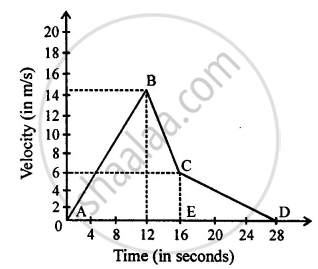
An aeroplane lands at 216 kmh−1 and stops after covering a runway of 2 m. Calculate the acceleration and the time, in which it comes to rest.
State if the following situation is possible:
A body moving horizontally with an acceleration in vertical direction.
What happens to the stepwise increasing speed-time graph when the size of each step is made very small?
The rate of change of velocity is ______.
Assertion: A negative acceleration of a body can be associated with speeding up of the body.
Reason: Increase in the speed of a moving body is independent of its direction of motion.
What is the difference between uniform acceleration and non–uniform acceleration?
