Advertisements
Advertisements
प्रश्न
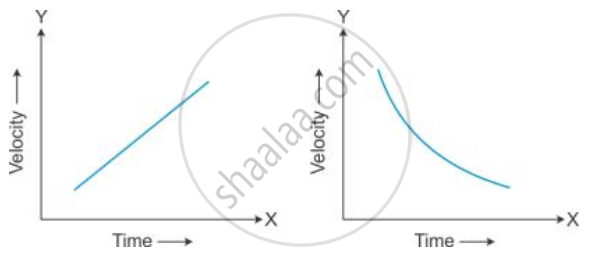
State the type of motion represented by the following sketches in Figures.
Give an example of each type of motion.
Advertisements
उत्तर
-
Type of Motion:Uniform Acceleration
-
The graph shows a straight line with a positive slope, indicating that velocity increases at a constant rate over time.
-
This means the object is accelerating uniformly.
Example:
A car increasing its speed steadily on a straight road (e.g., from 0 km/h to 60 km/h in 10 seconds at a constant rate). -
-
Type of Motion: Non-Uniform Retardation (Deceleration)
-
The graph shows a curved line with a decreasing slope, indicating that velocity is decreasing over time, but not at a constant rate.
-
This means the object is slowing down, and the rate of slowing down is changing.
Example:
A bicycle coming to a stop when brakes are applied gently and gradually. -
APPEARS IN
संबंधित प्रश्न
A body is moving vertically upwards. Its velocity changes at a constant rate from 50 m s−1 to 20 m s−1 in 3 s. What is its acceleration?
Draw velocity – time graph for the following situation:
When a body is moving with variable velocity, but uniform retardation.
A motorbike, initially at rest, picks up a velocity of 72 kmh−1 over a distance of 40 m. Calculate
- acceleration
- time in which it picks up above velocity.
What is the SI unit of acceleration?
Write the SI unit of acceleration and retardation.
Interpret the following graph: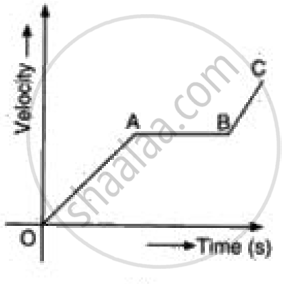
What happens to the stepwise increasing speed-time graph when the size of each step is made very small?
A car accelerates to a velocity of 30 m/s in 10 s and then decelerates for 20 s so that it stops. Draw a velocity-time graph to represent the motion and find:
The Deceleration.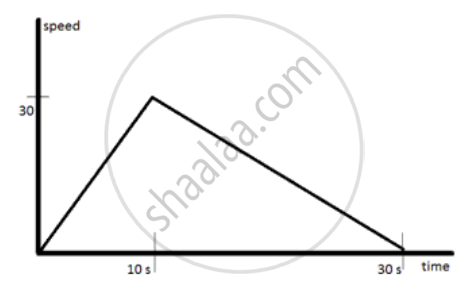
When an object undergoes acceleration ______.
The value of acceleration for a body at rest is ______.
