Advertisements
Advertisements
प्रश्न
What happens to the stepwise increasing speed-time graph when the size of each step is made very small?
Advertisements
उत्तर
The graph becomes straight line with positive slope with time axis and represents almost a constant acceleration.
APPEARS IN
संबंधित प्रश्न
An object of mass 16 kg is moving with an acceleration of 3 m/s2. Calculate the applied force. If the same force is applied to an object of mass 24 kg, how much will be the acceleration?
The unit of retardation is ____________
The velocity-time graph for a uniformly retarded body is a straight line inclined to the time axis with an obtuse angle. How is retardation calculated from the velocity-time graph?
Figure given below shows a velocity-time graph for a car starting from rest. The graph has three parts AB, BC and CD.
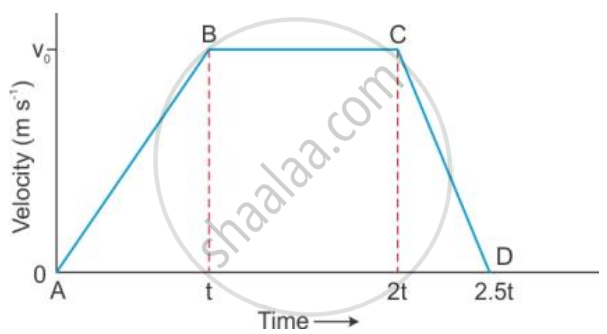
Which part of graph shows motion with uniform
(a) velocity (b) acceleration (c) retardation ?
A vehicle is accelerating on a straight road. Its velocity at any instant is 30 km/h. After 2 s, it is 33.6 km/h, and after further 2 s, it is 37.2 km/h. Find the acceleration of the vehicle in m s-2. Is the acceleration uniform?
A motor bike running at 90 kmh−1 is slowed down to 18 kmh−1 in 2.5 s. Calculate
- acceleration
- distance covered during slow down.
From the given v-t graph it can be inferred that an object is

Exercise Problem.
A racing car has a uniform acceleration of 4 ms–2. What distance it covers in 10 s after the start?
A bus accelerating with 4ms-2 changes its speed from 60ms_1 to a certain value in 5s. The final speed is ______.
Acceleration is a scalar.
