Advertisements
Advertisements
प्रश्न
A body moves along a circular path of radius r. When it completes three complete rounds, what is the ratio of distance covered to its displacement?
Advertisements
उत्तर
As after completing 3 revolution in circular motion the displacement is = 0.
so the ratio of distance covered to the displacement is infinite.
APPEARS IN
संबंधित प्रश्न
The displacement of a moving object in a given interval of time is zero. Would the distance travelled by the object also be zero ? Give reason for your answer.
Define displacement. State its unit.
State how the velocity-time graph can be used to find The displacement of the body in a given time.
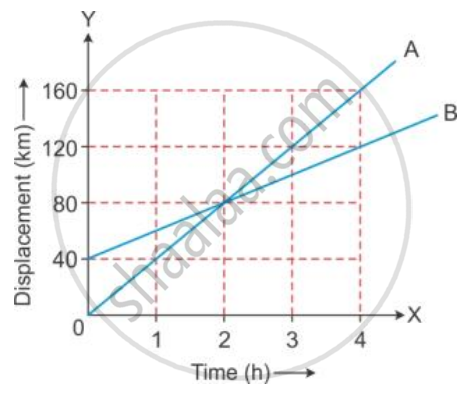
Figure ahead represents the displacement - time sketch of motion of two cars A and B . Find :
(i) the distance by which the car B was initially ahead of car A.
(ii) the velocities of car A and car B.
(iii) the time in which car A catches car B.
(iv) the distance from start when the car A will catch the car B.
A racehorse runs straight towards the north and covers 540 m in one minute. Calculate
- displacement of the horse,
- its velocity in (a) ms−1 (b) kmh−1.
Calculate the distance and displacement in the following case: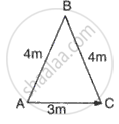
The figure represents graphically the velocity of a car moving along a straight road over a period of 100 hours.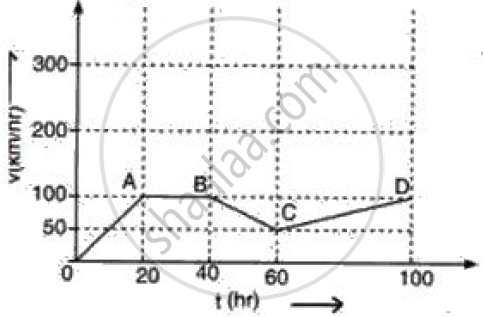
Calculate the distance travelled in the last 40 h.
State whether true or false. If false, correct the statement.
Distance covered by a particle never becomes zero but displacement becomes zero.
Slope of a velocity-time graph gives
An object is dropped from rest at a height of 150 m and simultaneously another object is dropped from rest at a height of 100 m. What is the difference in their heights after 2s if both the objects drop with the same accelerations? How does the difference in heights vary with time?
