Advertisements
Advertisements
प्रश्न
A racehorse runs straight towards the north and covers 540 m in one minute. Calculate
- displacement of the horse,
- its velocity in (a) ms−1 (b) kmh−1.
Advertisements
उत्तर
A racehorse runs straight towards the north and covers 540 m in one minute.
(i) Displacement = 540 m − north
(ii) Time = 1 minute = 60 s
Velocity = `"Displacement"/"Time"`
v = `540/60` = 9 ms−1
v = `(9xx3600)/100` km/h = `324/10` km/h
v = 32.4 km/h or kmh−1
APPEARS IN
संबंधित प्रश्न
What is the difference between distance travelled by a body and its displacement ? Explain with the
help of a diagram.
When is the magnitude of displacement equal to the distance?
What can you say about the nature of motion of a body if its displacement-time graph is A straight line inclined to the time axis with an acute angle?
Draw displacement – time graph for the following situation:
When a body is moving with uniform velocity.
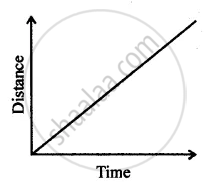
Can you suggest the kind of motion of a body from the following distance – time graph?
A motor car slows down from 72 kmh−1 to 36 kmh−1 over a distance of 25 m. If the brakes are applied with the same force
calculate
- total time in which car comes to rest
- distance travelled by it.
A body is moving along a circular path of radius r. What will be the distance and displacement of the body when it completes:
`(3/4)` th of a revolution
The graph shows how the velocity of a scooter varies with time in 50 s.
Work out: The distance traveled in 10 s, 20 s, and 50 s.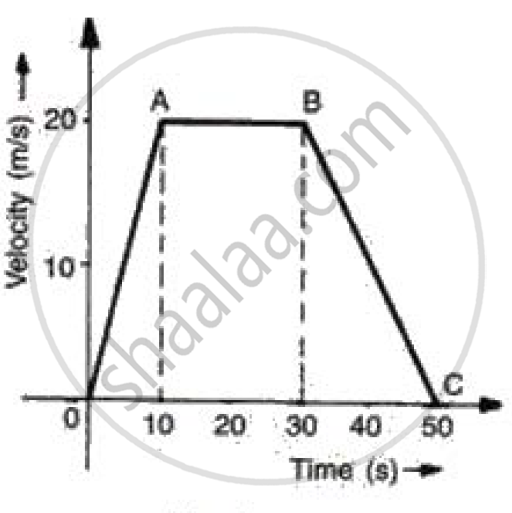
______ is the length of the actual path covered by a body.
The rate of change of displacement ______.
