Advertisements
Advertisements
Question
A racehorse runs straight towards the north and covers 540 m in one minute. Calculate
- displacement of the horse,
- its velocity in (a) ms−1 (b) kmh−1.
Advertisements
Solution
A racehorse runs straight towards the north and covers 540 m in one minute.
(i) Displacement = 540 m − north
(ii) Time = 1 minute = 60 s
Velocity = `"Displacement"/"Time"`
v = `540/60` = 9 ms−1
v = `(9xx3600)/100` km/h = `324/10` km/h
v = 32.4 km/h or kmh−1
APPEARS IN
RELATED QUESTIONS
Clarify the difference.
Distance and displacement
From the displacement-time graph of a cyclist given below in the Figure, find The displacement from the initial position at the end of 10 s,
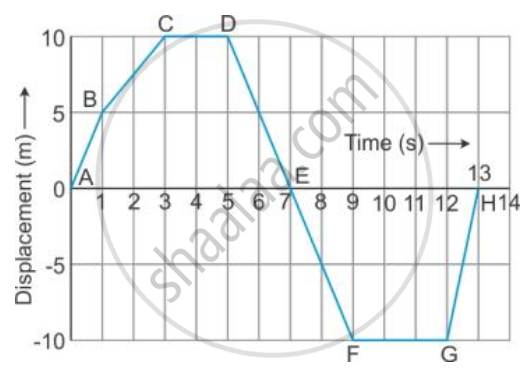
Figure given below shows a velocity-time graph for a car starting from rest. The graph has three parts AB, BC and CD.
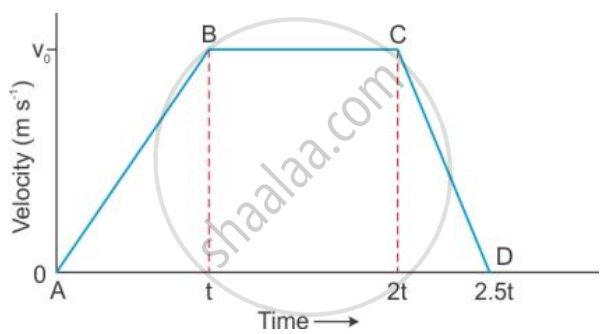
Compare the distance travelled in part BC with the distance travelled in part AB.
How can you find the following?
Displacement from velocity – time graph.
A motorbike running at 90 kmh−1, is slowed down to 54 kmh−1 by the application of brakes, over a distance of 40 m. If the brakes are applied with the same force, calculate
- total time in which bike comes to rest
- total distance travelled by bike.
Write two differences between distance and displacement.
A body is moving along a circular path of radius r. What will be the distance and displacement of the body when it completes:
Two full revolutions
Assertion: Displacement of a body may be zero when distance travelled by it is not zero.
Reason: The displacement is the shortest distance between initial and final position.
Write a note on the following:
Nautical mile
A body is projected up with an initial velocity of u m/s. It goes up to a height, ‘h’ meters in seconds' time. Then it comes back at the point of projection.
Considering negligible air resistance, which of the following statement is true?
