Advertisements
Advertisements
Question
Using the following data, draw time - displacement graph for a moving object:
| Time (s) | 0 | 2 | 4 | 6 | 8 | 10 | 12 | 14 | 16 |
| Displacement (m) | 0 | 2 | 4 | 4 | 4 | 6 | 4 | 2 | 0 |
Use this graph to find average velocity for the first 4 s, for the next 4 s and for the last 6 s.
Advertisements
Solution
From the given data, the displacement-time graph is shown as

Average velocity = `("Change in displacement")/("time interval")`
∴ For first 4s, v1 = `(4 - 0)/4`
= 1 ms−1
For next 4s v2 = `(4 - 4)/4`
= 0 ms−1
For last 6s v3 = `(0 - 6)/6`
= −1 ms−1
APPEARS IN
RELATED QUESTIONS
What is the difference between distance travelled by a body and its displacement ? Explain with the
help of a diagram.
If on a round trip you travel 6 km and then arrive back home :
What is your final displacement ?
When is the magnitude of displacement equal to the distance?
What can you say about the nature of motion of a body if its displacement-time graph is A straight line inclined to the time axis with an obtuse angle?
Figure given below shows a velocity-time graph for a car starting from rest. The graph has three parts AB, BC and CD.
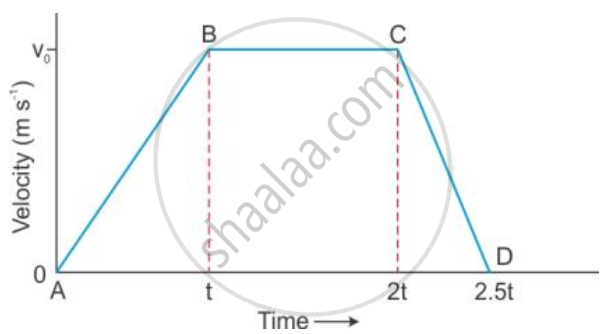
Compare the distance travelled in part BC with the distance travelled in part AB.
A particle moves along a circular path. How many times does it change its direction in two complete rounds?
The table below shows the distance travelled by two vehicles A and B during each second:
| Time (s) | 0 | 1 | 2 | 3 | 4 | 5 | 6 | 7 |
| Distance travelled by A (m) | 0 | 20 | 80 | 180 | 240 | 300 | 360 | 420 |
| Distance travelled by B (m) | 0 | 10 | 40 | 90 | 160 | 250 | 360 | 490 |
Which vehicle is moving with a constant acceleration?
The table below shows the distance travelled by two vehicles A and B during each second:
| Time (s) | 0 | 1 | 2 | 3 | 4 | 5 | 6 | 7 |
| Distance travelled by A (m) | 0 | 20 | 80 | 180 | 240 | 300 | 360 | 420 |
| Distance travelled by B (m) | 0 | 10 | 40 | 90 | 160 | 250 | 360 | 490 |
Give the value of the velocity at which they are meeting
Write a note on the following:
Nautical mile
Displacement is the ______ distance covered by a body.
