Advertisements
Advertisements
Question
The change in velocity of a motorbike is 54 kmh−1 in one minute. Calculate its acceleration in (a) ms−2 (b) kmh−2.
Advertisements
Solution
Change in velocity = 54 kmh−1 = `54xx1000/3600` ms−1 = 15 ms−1
Time = 1 minute = 60 s
Acceleration (a) = `"Change in velocity"/"Time"`
= `15/60` ms−2
a = 0.25 ms−2
a = `0.25xx1000/3600xx3600` kmh−2 = 3240 kmh−2
APPEARS IN
RELATED QUESTIONS
A toy car initially moving with uniform velocity of 18 km h-1 comes to a stop in 2 s. Find the retardation of the car in S.I. units.
The velocity-time graph for a uniformly retarded body is a straight line inclined to the time axis with an obtuse angle. How is retardation calculated from the velocity-time graph?
A ball is rolling from A to D on a flat and smooth surface. Its speed is 2 cm/s. On reaching B, it was pushed continuously up to C. On reaching D from C, its speed had become 4 cm/s. It took 2 seconds for it to go from B to C. What is the acceleration of the ball as it goes from B to C?

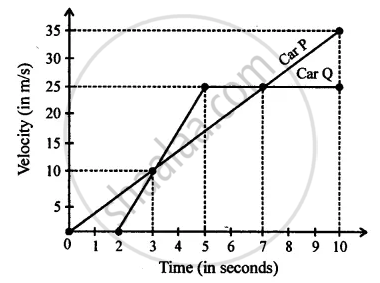
Diagram is given below shows velocity – time graph of car P and Q, starting from the same place and in the same direction. Calculate the Acceleration of car Q between 2 s – 5 s.
A cyclist driving at 5 ms−1, picks a velocity of 10 ms−1, over a distance of 50 m. Calculate
- acceleration
- time in which the cyclist picks up above velocity.
A cyclist driving at 36 kmh−1 stops his motion in 2 s, by the application of brakes. Calculate
- retardation
- distance covered during the application of brakes.
A bus can accelerate with an acceleration of 1 m/s2 . Find the minimum time for the bus to attain the speed of 100 km/s from 50 km /s.
The acceleration of the body that moves with a uniform velocity will be ______.
Acceleration is a scalar.
When a body is said to be in
- uniform acceleration
- non–uniform acceleration?
