Advertisements
Advertisements
Question
A car traveling at 60 km/h, stops on applying brakes in 10 seconds. What is its acceleration?
Advertisements
Solution
First convert 60 km/h in m/s.
60 km/hr =(60 X 1000)/3600 = 16.7 m/s.
This is initial velocity of car i.e u = 16.7 m/s.
As car stops in 10 seconds so final velocity is =0 m/s.
So acceleration = (v-u)/t = (0-16.7)/10 = -1.67 ms-2.
Acceleration of car is = -1.67 ms-2.
APPEARS IN
RELATED QUESTIONS
Give a scientific reason.
When an object falls freely to the ground, its acceleration is uniform.
Give one example of the following motion:
Uniform retardation
Figure given below shows a velocity-time graph for a car starting from rest. The graph has three parts AB, BC and CD.
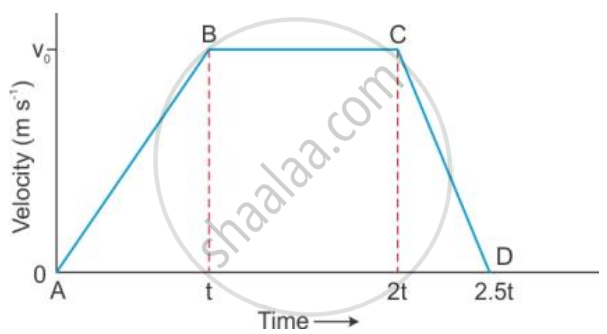
Which part of graph shows motion with uniform
(a) velocity (b) acceleration (c) retardation ?
Draw velocity – time graph for the following situation:
When a body is moving with variable velocity and variable acceleration.
A motor bike running at 90 kmh−1 is slowed down to 18 kmh−1 in 2.5 s. Calculate
- acceleration
- distance covered during slow down.
Interpret the following graph: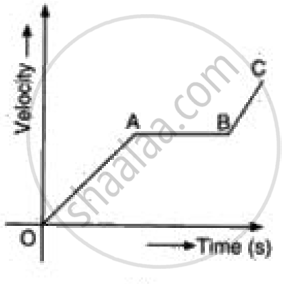
The graph shows how the velocity of a scooter varies with time in 50 s.
Work out: Acceleration.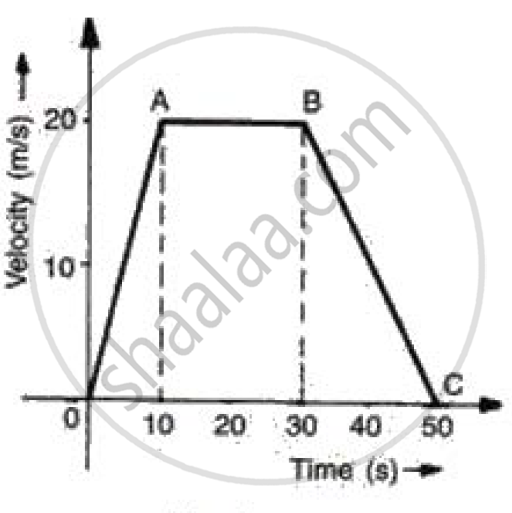
A car accelerates to a velocity of 30 m/s in 10 s and then decelerates for 20 s so that it stops. Draw a velocity-time graph to represent the motion and find:
The Deceleration.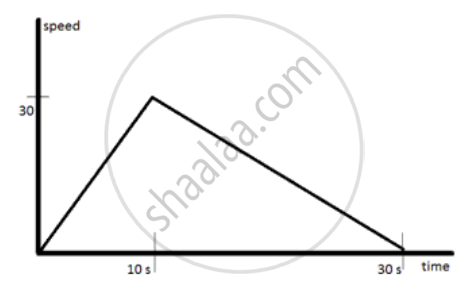
Correct your friend who says that acceleration gives the idea of how fast the position changes.
What do you understand about negative acceleration?
