Advertisements
Advertisements
प्रश्न
A car traveling at 60 km/h, stops on applying brakes in 10 seconds. What is its acceleration?
Advertisements
उत्तर
First convert 60 km/h in m/s.
60 km/hr =(60 X 1000)/3600 = 16.7 m/s.
This is initial velocity of car i.e u = 16.7 m/s.
As car stops in 10 seconds so final velocity is =0 m/s.
So acceleration = (v-u)/t = (0-16.7)/10 = -1.67 ms-2.
Acceleration of car is = -1.67 ms-2.
APPEARS IN
संबंधित प्रश्न
Define the term acceleration due to gravity. State its average value.
A body is moving vertically upwards. Its velocity changes at a constant rate from 50 m s−1 to 20 m s−1 in 3 s. What is its acceleration?
Draw velocity – time graph for the following situation:
When a body is moving with variable velocity and variable acceleration.
Diagram is given below shows velocity – time graph of car P and Q, starting from the same place and in the same direction. Calculate the Acceleration of car P.
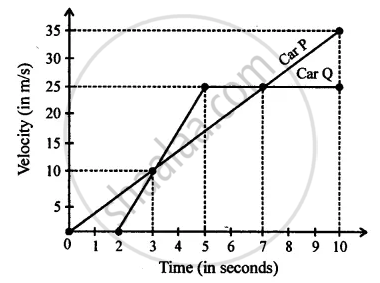
A cyclist driving at 5 ms−1, picks a velocity of 10 ms−1, over a distance of 50 m. Calculate
- acceleration
- time in which the cyclist picks up above velocity.
The distance covered by a body is directly proportional to the square of the time elapsed. What can you say about its acceleration?
Assertion: The accelerated motion of an object may be due to change in magnitude of velocity or direction or both of them.
Reason: Acceleration can be produced only by change in magnitude of the velocity. It does not depend the direction.
When a body starts from rest, the acceleration of the body after 2 seconds in ______ of its displacement.
It is possible to have objects moving with uniform speed but variable acceleration.
Assertion: A negative acceleration of a body can be associated with speeding up of the body.
Reason: Increase in the speed of a moving body is independent of its direction of motion.
