Advertisements
Advertisements
Question
Exercise Problem.
A racing car has a uniform acceleration of 4 ms–2. What distance it covers in 10 s after the start?
Advertisements
Solution
Given: acceleration = 4ms– 2.
time = 10s and initial velocity = 0
Formula: s = ut + 1/2 at2
Solution:
distance covered s = 0 × t + 1/2 × 4 ms– 2 × (10 s)2.
s = 1/2 × 4 ms– 2 × 100 s2
= 1/2 × 400m
= 200m
APPEARS IN
RELATED QUESTIONS
A body is moving vertically upwards. Its velocity changes at a constant rate from 50 m s−1 to 20 m s−1 in 3 s. What is its acceleration?
Figure given below shows a velocity-time graph for a car starting from rest. The graph has three parts AB, BC and CD.
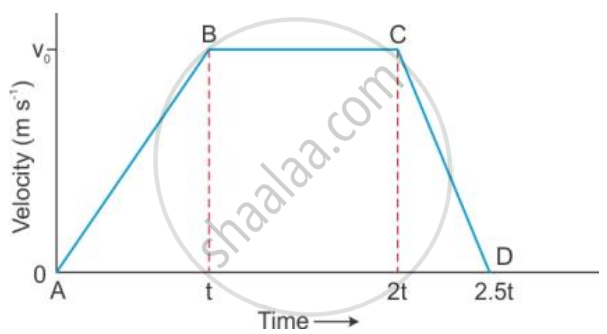
Which part of graph shows motion with uniform
(a) velocity (b) acceleration (c) retardation ?
Write the SI unit of retardation.
State if the following situation is possible:
A body moving with constant acceleration but with Zero velocity.
Is it possible for an accelerating body to have constant speed?
A car is moving with a speed of 50 km/h. One second later, its speed is 55 km/h. What is its acceleration?
A car starts from rest and it is travelling with a velocity of 20 m/s in 10 s. What is its acceleration?
The Unit of acceleration is ______.
When a body starts from rest, the acceleration of the body after 2 seconds in ______ of its displacement.
The acceleration of the body that moves with a uniform velocity will be ______.
