Advertisements
Advertisements
प्रश्न
Exercise Problem.
A racing car has a uniform acceleration of 4 ms–2. What distance it covers in 10 s after the start?
Advertisements
उत्तर
Given: acceleration = 4ms– 2.
time = 10s and initial velocity = 0
Formula: s = ut + 1/2 at2
Solution:
distance covered s = 0 × t + 1/2 × 4 ms– 2 × (10 s)2.
s = 1/2 × 4 ms– 2 × 100 s2
= 1/2 × 400m
= 200m
APPEARS IN
संबंधित प्रश्न
Give a scientific reason.
When an object falls freely to the ground, its acceleration is uniform.
Define the term acceleration due to gravity. State its average value.
The unit of retardation is ____________
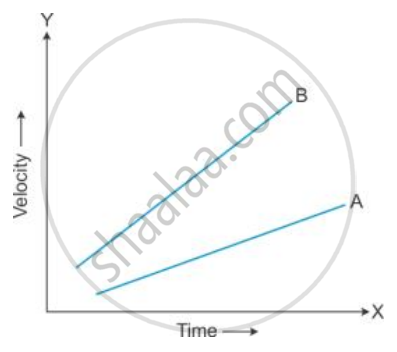
Figure shows the velocity-time graphs for two cars A and B moving in the same direction. Which car has greater acceleration? Give reasons to your answer.
A vehicle is accelerating on a straight road. Its velocity at any instant is 30 km/h. After 2 s, it is 33.6 km/h, and after further 2 s, it is 37.2 km/h. Find the acceleration of the vehicle in m s-2. Is the acceleration uniform?
A racing car, initially at rest, picks up a velocity of 180 kmh−1 in 4.5 s. Calculate
- acceleration
- distance covered by the car.
A car accelerates to a velocity of 30 m/s in 10 s and then decelerates for 20 s so that it stops. Draw a velocity-time graph to represent the motion and find:
The acceleration.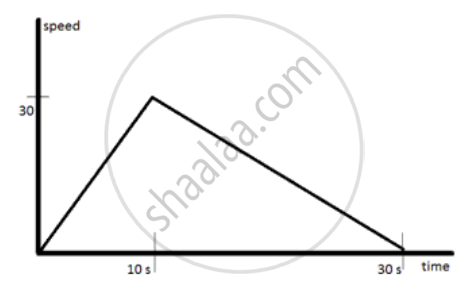
Figure represents graphically the velocity of a car moving along a straight road over a period of 100 hours.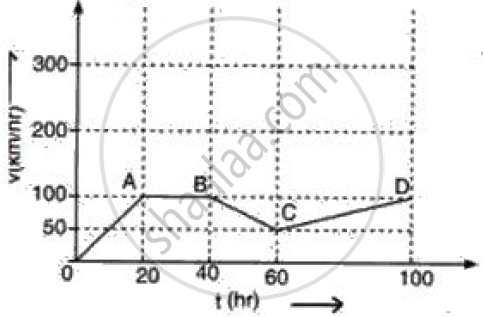
Calculate the acceleration along AB and the retardation along BC.
When an object undergoes acceleration ______.
Acceleration is defined as the rate of change of ______.
