Advertisements
Advertisements
प्रश्न
The velocity-time graph for a uniformly retarded body is a straight line inclined to the time axis with an obtuse angle. How is retardation calculated from the velocity-time graph?
Advertisements
उत्तर
retardation is calculated by finding the negative slope.
APPEARS IN
संबंधित प्रश्न
Give one example of the following motion:
Uniform retardation
A body is moving vertically upwards. Its velocity changes at a constant rate from 50 m s−1 to 20 m s−1 in 3 s. What is its acceleration?
State the type of motion represented by the following sketches in Figures.
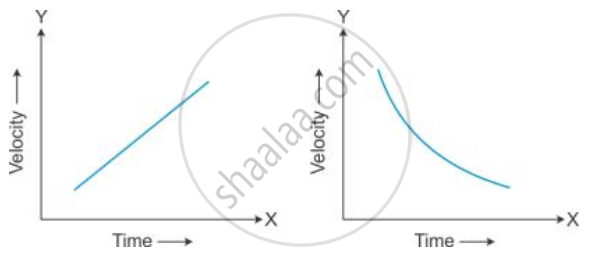
Give an example of each type of motion.
A train starts from rest and accelerates uniformly at a rate of 2 m s−2 for 10 s. It then maintains a constant speed for 200 s. The brakes are then applied and the train is uniformly retarded and comes to rest in 50 s. Find
- The maximum velocity reached,
- The retardation in the last 50 s,
- The total distance travelled,
- The average velocity of the train.
A motor bike running at 5 ms−1, picks up a velocity of 30 ms−1 in 5s. Calculate
- acceleration
- distance covered during acceleration.
Write the SI unit of acceleration and retardation.
What happens to the stepwise increasing speed-time graph when the size of each step is made very small?
A body has an acceleration of -3.5 ms-2. What is its retardation?
Convert the following acceleration:
1/36 m/s2 into km/h2
m/s2 is the unit of ______.
