Advertisements
Advertisements
प्रश्न
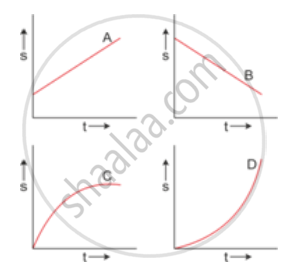
The figure shows the displacement - time graph for four bodies A, B C and D. In each case state what information do you get about the acceleration (zero, positive or negative).
Advertisements
उत्तर
For body A: The graph is a straight line. So, the slope gives constant velocity. Hence, the acceleration for body A is zero.
For body B: The graph is a straight line. So, the slope gives constant velocity. Hence, the acceleration for body B is also zero.
For body C: The slope of the graph is decreasing with time. Hence, the acceleration is negative.
For body D: The slope of the graph is increasing with time. Hence, the acceleration is positive.
APPEARS IN
संबंधित प्रश्न
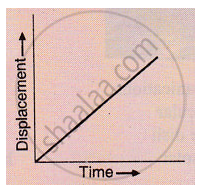
What conclusion can you draw about the velocity of a body from the displacement-time graph shown below :
Fill in the following blank with suitable word :
If a body moves with uniform velocity, its acceleration is ..............
Describe the motion of a body which is accelerating at a constant rate of 10 m s–2. If the body starts from rest, how much distance will it cover in 2 s ?
A car acquire a velocity of 72 km per hour in 10 second starting from rest. Find
(1) the acceleration,
(2) the average velocity, and
(3) the distance travelled in this time.
A car is travelling along the road at 8 ms-1. It accelerates at 1 ms-2 for a distance of 18 m. How fast is it then travelling ?
Differentiate between uniform acceleration and variable acceleration.
State how the velocity-time graph can be used to find
The acceleration of a body
Multiple choice Question. Select the correct option.
A body dropped from the top of a tower reaches the ground in 4s. Height of the tower is
A stone thrown vertically upwards takes 3 s to attain maximum height. Calculate
- initial velocity of the stone
- maximum height attained by the stone. (Take g = 9.8 ms−2)
An object starting from rest travels 20 m in the first 2 s and 160 m in the next 4 s. What will be the velocity after 7 s from the start?
