Advertisements
Advertisements
प्रश्न
Derive the formula : v = u + at, where the symbols have usual meanings.
Advertisements
उत्तर
Consider a body has initial velocity (u) . Suppose it is subjected to a uniform acceleration (a) such that after time (t) its final velocity becomes (v). Now, from the definition of acceleration we know that:
Acceleration = `"Change in velocity"/"Time taken"`
The above expression can also be written as ,
`a = (v-u)/t`
On further simplification, we get the 1st equation of motion,
v = u + at
Where,
(a) - Acceleration
(v) - Final velocity
(u) - Initial velocity
(t) - Time taken
The equation v = u + at is called the first equation of motion and is used to calculate the velocity 'v' acquired by a body in time 't'.
APPEARS IN
संबंधित प्रश्न
Which of the two can be zero under certain conditions : average speed of a moving body or average velocity of a moving body ?
What is meant by the term acceleration ? State the SI unit of acceleration.
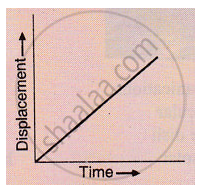
What conclusion can you draw about the velocity of a body from the displacement-time graph shown below :
Describe the motion of a body which is accelerating at a constant rate of 10 m s–2. If the body starts from rest, how much distance will it cover in 2 s ?
Which of the following could not be a unit of acceleration?
A body, initially at rest, starts moving with a constant acceleration 2 m s-2. Calculate: (i) the velocity acquired and (ii) the distance travelled in 5 s.
What do you understand by the term acceleration?
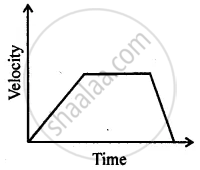
Can you suggest a real-life example about the motion of a body from the following velocity – time graph?
An object starting from rest travels 20 m in the first 2 s and 160 m in the next 4 s. What will be the velocity after 7 s from the start?
An electron moving with a velocity of 5 × 10⁴ ms−1 enters into a uniform electric field and acquires a uniform acceleration of 104 ms–2 in the direction of its initial motion.
(i) Calculate the time in which the electron would acquire a velocity double of its initial velocity.
(ii) How much distance the electron would cover at this time?
