Advertisements
Advertisements
प्रश्न
A freely falling object travels 4.9 m in 1st second, 14.7 m in 2 nd second, 24.5 m in 3rd second, and so on. This data shows that the motion of a freely falling object is a case of :
विकल्प
uniform motion
uniform acceleration
no acceleration
uniform velocity
Advertisements
उत्तर
uniform acceleration
The displacement of the body in equal interval of time is unequal, but acceleration is constant. The acceleration will thus be uniform, so the answer is (b).
APPEARS IN
संबंधित प्रश्न
Fill in the following blank with a suitable word:
Acceleration is the rate of change of ______ It is measured in ______
What term is used to denote the change of velocity with time ?
Explain why, the motion of a body which is moving with constant speed in a circular path is said to be accelerated.
A motorcycle moving with a speed of 5 m/s is subjected to an acceleration of 0.2 m/s2. Calculate the speed of the motorcycle after 10 seconds, and the distance travelled in this time.
The velocity-time graph of a body in motion is a straight line inclined to the time axis. The correct statement is ___________
What do you understand by the term acceleration?
How can you find the following?
Acceleration from velocity – time graph.
Can you suggest a real-life example about the motion of a body from the following velocity – time graph?
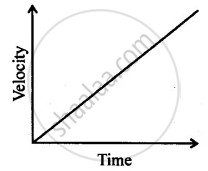
How will the equations of motion for an object moving with a uniform velocity change?
Two stones are thrown vertically upwards simultaneously with their initial velocities u1 and u2 respectively. Prove that the heights reached by them would be in the ratio of `"u"_1^2 : "u"_2^2` (Assume upward acceleration is –g and downward acceleration to be +g)
