Advertisements
Advertisements
प्रश्न
An electron moving with a velocity of 5 × 10⁴ ms−1 enters into a uniform electric field and acquires a uniform acceleration of 104 ms–2 in the direction of its initial motion.
(i) Calculate the time in which the electron would acquire a velocity double of its initial velocity.
(ii) How much distance the electron would cover at this time?
Advertisements
उत्तर
Here initial velocity of the electron,
u = 5 × 10⁴ ms−1
acceleration, a = 104 ms−2
(i) v = 2u = 2 × 5 × 104 ms−1
= 10 ×104 ms
using v = u + at we get
10 × 104 = 5 × 10⁴ + 104 × t or t = 5s
(ii) Using s = `"ut" + 1/2 "at"^2`, we get
s = `5 xx 10^4 xx 5 + 1/2 xx 10^4 xx 5^2`
= 25 × 104 + 12.5 × 104
= 37.5 × 10⁴ m.
APPEARS IN
संबंधित प्रश्न
Fill in the following blank with suitable word :
Velocity is the rate of change of……………………… It is measured in.............. .
What term is used to denote the change of velocity with time ?
What is meant by the term acceleration ? State the SI unit of acceleration.
Fill in the following blank with suitable word :
If a body moves with uniform velocity, its acceleration is ..............
Describe the motion of a body which is accelerating at a constant rate of 10 m s–2. If the body starts from rest, how much distance will it cover in 2 s ?
Derive the formula : v = u + at, where the symbols have usual meanings.
A car acquire a velocity of 72 km per hour in 10 second starting from rest. Find
(1) the acceleration,
(2) the average velocity, and
(3) the distance travelled in this time.
Give one example of following motion :
Variable acceleration
How can you find the following?
Acceleration from velocity – time graph.
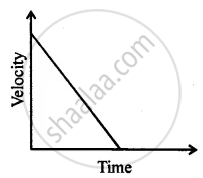
Can you suggest a real-life example about the motion of a body from the following velocity – time graph?