Advertisements
Advertisements
प्रश्न
An electron moving with a velocity of 5 × 10⁴ ms−1 enters into a uniform electric field and acquires a uniform acceleration of 104 ms–2 in the direction of its initial motion.
(i) Calculate the time in which the electron would acquire a velocity double of its initial velocity.
(ii) How much distance the electron would cover at this time?
Advertisements
उत्तर
Here initial velocity of the electron,
u = 5 × 10⁴ ms−1
acceleration, a = 104 ms−2
(i) v = 2u = 2 × 5 × 104 ms−1
= 10 ×104 ms
using v = u + at we get
10 × 104 = 5 × 10⁴ + 104 × t or t = 5s
(ii) Using s = `"ut" + 1/2 "at"^2`, we get
s = `5 xx 10^4 xx 5 + 1/2 xx 10^4 xx 5^2`
= 25 × 104 + 12.5 × 104
= 37.5 × 10⁴ m.
APPEARS IN
संबंधित प्रश्न
What term is used to denote the change of velocity with time ?
Explain why, the motion of a body which is moving with constant speed in a circular path is said to be accelerated.
A motorcycle moving with a speed of 5 m/s is subjected to an acceleration of 0.2 m/s2. Calculate the speed of the motorcycle after 10 seconds, and the distance travelled in this time.
A train travelling at 20 m s-1 accelerates at 0.5 m s-2 for 30 s. How far will it travel in this time ?
A body starting from rest travels with uniform acceleration. If it travels 100 m in 5 s, what is the value of acceleration ?
How can you find the following?
Velocity from acceleration – time graph.
Can you suggest a real-life example about the motion of a body from the following velocity – time graph?
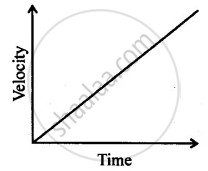
Can you suggest a real-life example about the motion of a body from the following velocity – time graph?
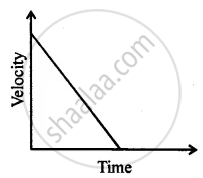
Area under a v – t graph represents a physical quantity which has the unit
An object starting from rest travels 20 m in the first 2 s and 160 m in the next 4 s. What will be the velocity after 7 s from the start?
