Advertisements
Advertisements
प्रश्न
A car starting from rest acquires a velocity 180m s-1 in 0.05 h. Find the acceleration.
Advertisements
उत्तर
Here, final velocity = 180 m/s
Initial velocity = 0 m/s
Time taken = 0.05 h or 180 s
Acceleration = (Final Velocity - Initial Velocity)/time
= (180-0)/180 m s-2
= 1 m s-2
APPEARS IN
संबंधित प्रश्न
A bus decreases its speed from 80 km h−1 to 60 km h−1 in 5 s. Find the acceleration of the bus.
A bus running at a speed of 18 km/h is stopped in 2.5 seconds by applying brakes. Calculate the retardation produced.
A body starting from rest travels with uniform acceleration. If it travels 100 m in 5 s, what is the value of acceleration ?
A boy is sitting on a merry-go-round which is moving with a constant speed of 10 m s−1. This means that the boy is :
A freely falling object travels 4.9 m in 1st second, 14.7 m in 2 nd second, 24.5 m in 3rd second, and so on. This data shows that the motion of a freely falling object is a case of :
Derive the following equations for uniformly accelerated motion:
(i) v = u + at
(ii) `"S = ut" + 1/2 "at"^2`
(iii) v2 = u2 + 2aS
where the symbols have their usual meanings.
Multiple choice Question. Select the correct option.
The speed of a car reduces from 15 m/s to 5 m/s over a displacement of 10 m. The uniform acceleration of the car is :
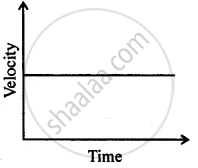
Can you suggest a real-life example about the motion of a body from the following velocity – time graph?
The velocity-time graph (Fig. 8.5) shows the motion of a cyclist. Find (i) its acceleration (ii) its velocity and (iii) the distance covered by the cyclist in 15 seconds.

Draw a velocity versus time graph of a stone thrown vertically upwards and then coming downwards after attaining the maximum height.
