Advertisements
Advertisements
प्रश्न
A car is travelling along the road at 8 ms-1. It accelerates at 1 ms-2 for a distance of 18 m. How fast is it then travelling ?
Advertisements
उत्तर
We have to find the final velocity of the moving object. And we have the following information
Initial velocity, (u) = 8 m/s
Acceleration, (a) = 1 m/s2
Distance, (s) = 18 m
So applying 3rd equation of motion to calculate the final velocity,
`ν = sqrt(u^2 + 2as)`
Where,
(a) - Acceleration
(ν) - Final velocity
(u) - Initial velocity
(s) - Distance
Put the values in the above equation to get the value of final velocity,
`ν = sqrt(64 + 36)` m/s
= `sqrt(100)` m/s
= 10 m/s
APPEARS IN
संबंधित प्रश्न
Fill in the following blank with a suitable word:
Acceleration is the rate of change of ______ It is measured in ______
Find the initial velocity of a car which is stopped in 10 seconds by applying brakes. The retardation due to brakes is 2.5 m/s2.
A cheetah starts from, rest, and accelerates at 2 m/s2 for 10 seconds. Calculate :
(a) the final velocity
(b) the distance travelled.
A bus increases its speed from 36 km/h to 72 km/h in 10 seconds. Its acceleration is :
State how the velocity-time graph can be used to find
The acceleration of a body
The figure shows the displacement - time graph for four bodies A, B C and D. In each case state what information do you get about the acceleration (zero, positive or negative).
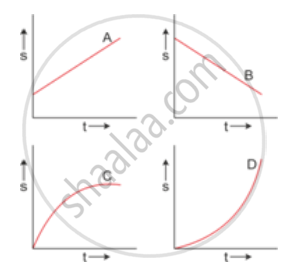
The velocity-time graph of a body in motion is a straight line inclined to the time axis. The correct statement is ___________
For a uniformly retarded motion, the velocity-time graph is _____________
How will the equations of motion for an object moving with a uniform velocity change?
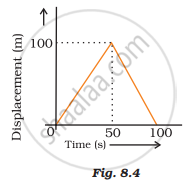
A girl walks along a straight path to drop a letter in the letterbox and comes back to her initial position. Her displacement–time graph is shown in Fig.8.4. Plot a velocity-time graph for the same.