Advertisements
Advertisements
प्रश्न
A bicycle initially moving with a velocity 5.0 m s-1 accelerates for 5 s at a rate of 2 m s-2. What will be its final velocity?
Advertisements
उत्तर
Initial velocity of the bicycle, u = 5 m/s
Acceleration = 2 m/s2
Given time, t = 5 s
Let 'v' be the final velocity.
We know that, acceleration = Rate of change of velocity/time
= (Final velocity - Initial velocity)/time
Or 2 = (v - 5)/5
Or, 10 = (v - 5)
Or, v = 5 + 10
Or, v = 15 m/s
APPEARS IN
संबंधित प्रश्न
When will you say a body is at non-uniform acceleration?
Name the physical quantity whose SI unit is :
(a) m/s (b) m/s2
Fill in the following blank with suitable word :
A motorcycle has a steady……………. of 3 m/s2. This means that every………………. its…………….. increases by………….
What conclusion can you draw about the velocity of a body from the displacement-time graph shown below :
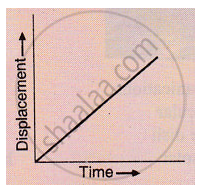
Name the quantity which is measured by the area occupied under the velocity-time graph.
Derive the formula : v = u + at, where the symbols have usual meanings.
A bus increases its speed from 36 km/h to 72 km/h in 10 seconds. Its acceleration is :
For a uniformly retarded motion, the velocity-time graph is _____________
A stone thrown vertically upwards takes 3 s to attain maximum height. Calculate
- initial velocity of the stone
- maximum height attained by the stone. (Take g = 9.8 ms−2)
When will you say a body is at uniform acceleration?
