Advertisements
Advertisements
प्रश्न
A car is moving with a velocity 20 m s-1. The brakes are applied to retard it at a rate of 2 m s-2. What will be the velocity after 5 s of applying the brakes?
Advertisements
उत्तर
Initial velocity of the car, u = 20 m/s
Retardation = 2 m/s2
Given time, t = 5 s
Let 'v' be the final velocity.
We know that, Acceleration = Rate of change of velocity/time
= (Final velocity - Initial velocity)/time
⇒ - 2 = `("v" - 20)/5`
⇒ - 2 × 5 = v - 20
⇒ - 10 = v - 20
⇒ - 10 + 20 = v
⇒ v = 10 m/s
Hence, final velocity = 10 m s-1.
APPEARS IN
संबंधित प्रश्न
Name the physical quantity obtained by dividing ‘Distance travelled’ by ‘Time taken’ to travel that distance.
A car is moving along a straight road at a steady speed. It travels 150 m in 5 seconds:
How far does it travel in 1 second ?
A car travels 100 km at a speed of 60 km/h and returns with a speed of 40 km/h. Calculate the average speed for the whole journey.
The tip of seconds’ hand of a dock takes 60 seconds to move once on the circular dial of the clock. If the radius of the dial of the clock be 10.5 cm, calculate the speed of the tip of the seconds’ hand of the clock. `("Given" π= 22/7)`.
The speed of a moving object is determined to be 0.06 m/s. This speed is equal to :
When is a body said to be in motion?
A train takes 2 h to reach station B from station A, and then 3 h to return from station B to station A. The distance between the two stations is 200 km. Find:
The average speed,
The average velocity of the train.
A car is moving in a straight line with speed 18 km h-1. It is stopped in 5 s by applying the brakes. Find:
- the speed of car in m s-1
- the retardation and
- the speed of car after 2 s of applying the brakes.
A train travels with a speed of 60 km h-1 from station A to station B and then comes back with a speed 80 km h-1 from station B to station A. Find -
- The average speed
- The average velocity of the train.
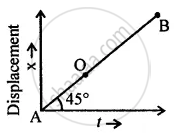
Write down the type of motion of a body along with the A – O – B of the following distance – time graph.