Advertisements
Advertisements
प्रश्न
A car is moving with a velocity 20 m s-1. The brakes are applied to retard it at a rate of 2 m s-2. What will be the velocity after 5 s of applying the brakes?
Advertisements
उत्तर
Initial velocity of the car, u = 20 m/s
Retardation = 2 m/s2
Given time, t = 5 s
Let 'v' be the final velocity.
We know that, Acceleration = Rate of change of velocity/time
= (Final velocity - Initial velocity)/time
⇒ - 2 = `("v" - 20)/5`
⇒ - 2 × 5 = v - 20
⇒ - 10 = v - 20
⇒ - 10 + 20 = v
⇒ v = 10 m/s
Hence, final velocity = 10 m s-1.
APPEARS IN
संबंधित प्रश्न
Convert a speed of 54 km/h into m/s.
A car is moving along a straight road at a steady speed. It travels 150 m in 5 seconds:
How far does it travel in 6 seconds ?
A ball hits a wall horizontally at 6.0 m s-1. It rebounds horizontally at 4.4 m s-1. The ball is in contact with the wall for 0.040 s. What is the acceleration of the ball ?
The speed of a car is 72 km h-1. Express it in m s-1.
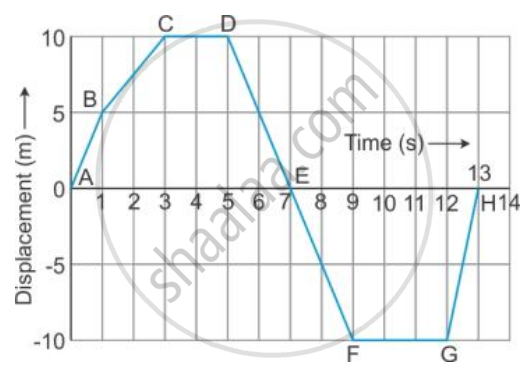
From the displacement-time graph of a cyclist given below in the Figure, find The average velocity in the first 4 s.
What is the relation between distance and time when the body is moving with variable velocity?
Draw a diagram to show the motion of a body whose speed remains constant, but velocity changes continuously.
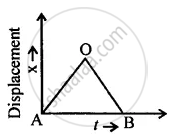
Write down the type of motion of a body along with the A – O – B of the following distance – time graph.
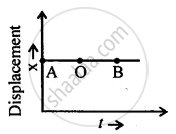
Write down the type of motion of a body along with the A – O – B of the following distance – time graph.