Advertisements
Advertisements
प्रश्न
Distinguish between speed and velocity.
Advertisements
उत्तर
| Speed | Velocity | |
|
1. |
Speed is simply the rate of change of motion. or simply, it is the distance travelled by a body in a unit of time. |
Velocity is direction-aware, and it is the rate of change of position of an object. |
| 2. | Speed is a scalar quantity, i.e. it has only magnitude. | Velocity is a vector quantity, i.e. it has both magnitude and direction. |
| 3. | Speed measures the distance travelled (d) over the change in time (Δt). | Velocity measures displacement (or change in position, Δs) over the change in time (Δt). |
|
4. |
Speed = `"Distance"/"time"` = dt |
Velocity = `"Displacement"/"Time"` = st |
| 5. | Speed ascertains how fast a body moves. | Velocity ascertains the object's speed and the direction it takes while moving. |
|
6. |
Example: A person is making a roundabout journey at a speed of 30 mph. |
Example: A woman plans to drive her car at 56 mph in East Mumbai. |
संबंधित प्रश्न
Give one example of following motion :
Uniform velocity
Express 15 m s-1 in km h-1.
Draw the shape of the velocity-time graph for a body moving with (a) Uniform velocity and (b) Uniform acceleration.
From the displacement-time graph of a cyclist given below in the Figure, find The average velocity in the first 4 s.
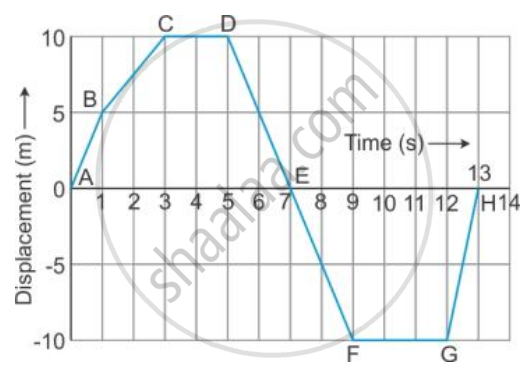
The velocity-time graph of a moving body is given below in Figure
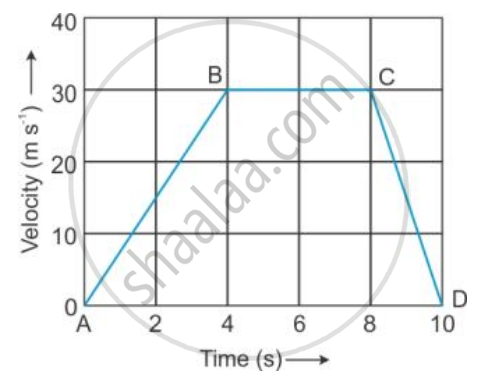
Displacement in each part AB, BC and CD.
Define uniform velocity and give one example.
Write down the type of motion of a body along with the A – O – B of the following distance – time graph.
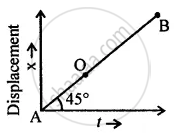
Define speed of a body.
What are the uses of equations of motion?
Which of the following figures (Fig. 8.3) represents uniform motion of a moving object correctly?
