Advertisements
Advertisements
प्रश्न
A car accelerates at a rate of 5 m s-2. Find the increase in its velocity in 2 s.
Advertisements
उत्तर
Acceleration = Increase in velocity/time taken
Therefore, increase in velocity = Acceleration × time taken
= (5 × 2) m/s
= 10 m/s
APPEARS IN
संबंधित प्रश्न
Write the formula for acceleration. Give the meaning of each symbol which occurs in it.
Write the formula to calculate the speed of a body moving along a circular path. Give the meaning of each symbol which occurs in it.
Give an example of the motion of a body moving with a constant speed but with a variable velocity. Draw a diagram to represent such a motion.
Give one example of following motion :
Uniform velocity
Express the following in m s-1.
18 km min-1
For the motion with uniform velocity , how is the distance travelled related to the time ?
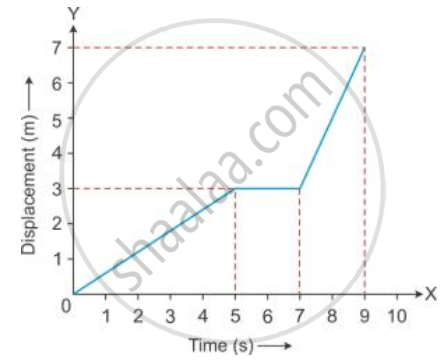
Figure shows the displacement of a body at different times .
Calculate the velocity of the body as it moves for time interval :
(i) 0 to 5 s,
(ii) 5 s to 7 s
(iii) 7 s to 9 s.
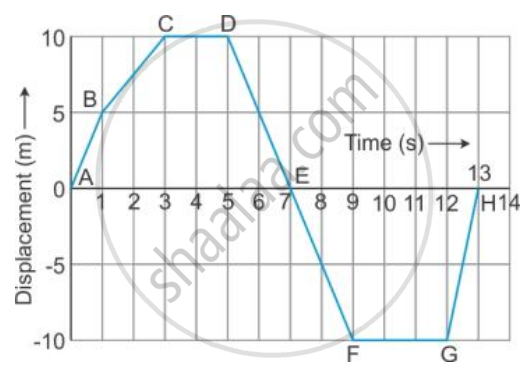
From the displacement-time graph of a cyclist given below in the Figure, find The average velocity in the first 4 s.
Draw a diagram to show the motion of a body whose speed remains constant, but velocity changes continuously.
What are the uses of equations of motion?
