Advertisements
Advertisements
प्रश्न
Joseph jogs from one end A to the other end B of a straight 300 m road in 2 minutes 30 seconds and then turns around and jogs 100 m back to point C in another 1 minute. What are Joseph’s average speeds and velocities in jogging?
- from A to B and
- from A to C?
Advertisements
उत्तर
(a) From A to B.
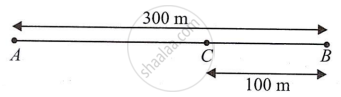
Time for A to B = 2 min 30s
= 2 × 60 + 30
= 150 s
`"Average speed" = "total distance"/ "time interval"`
= `300/150`
= 2 ms-1
`"Average velocity" = "displacement"/ "time interval"`
= `300/150`
= 2 ms-1
(b) From A to C.
Time taken = A to B + B to C
= 150 + 60
= 210 s
Total distance = 300 + 100
= 400 m
∴ `"Average speed" = "total distace"/"time interval"`
= `400/210 `
= 1.9 m s-1
∴ `"Average velocity" = "displacement"/"time interval"`
= `200/210`
= 0.95 ms-1
APPEARS IN
संबंधित प्रश्न
What is the Differnece between speed and velocity ?
Give one example of a motion where an object does not change its speed but its direction of motion changes continuously.
A car moving on a straight path covers a distance of 1 km due east in 100 s. What is the speed of the car?
Figure shows the displacement of a body at different times .
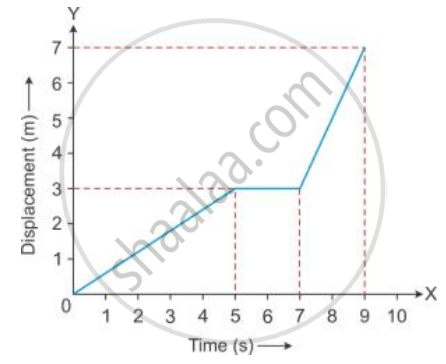
Calculate the average velocity during the time interval 5 s to 9 s ,
[Hint : From 5 s to 9 s , displacement = 7 m - 3m = 4m]
The velocity-time graph of a moving body is given below in Figure
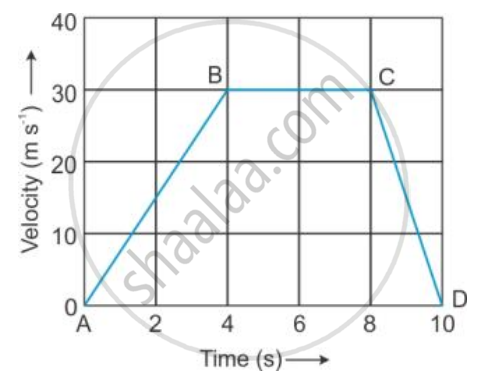
The acceleration in parts AB, BC and CD.
A train is moving with a velocity of 90 km h-1 . It is brought to stop by applying the brakes which produce a retardation of 0.5 ms-2 Find :
(i) The velocity after 10 s , and
(ii) the time taken by the train to come to rest .
Define average velocity and give one example.
What is the relation between distance and time when the body is moving with uniform velocity?
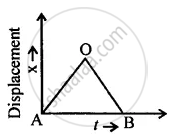
Write down the type of motion of a body along with the A – O – B of the following distance – time graph.
Define speed of a body.
