Advertisements
Advertisements
प्रश्न
A train takes 2 h to reach station B from station A, and then 3 h to return from station B to station A. The distance between the two stations is 200 km. Find:
The average speed,
The average velocity of the train.
Advertisements
उत्तर
Here, total distance = (200 + 200) km = 400 km
Total time taken = (2 + 3) h = 5 h
(i) Average speed = Total distance travelled/total time taken = `(400 "km")/(5 "h")` = 80 km h-1
(ii) Average velocity of the train is zero because the train stops at the same point from where it starts, i.e. the displacement is zero.
APPEARS IN
संबंधित प्रश्न
In addition to speed, what else should we know to predict the position of a moving body ?
Which of the following could not be a unit of speed?
Give an example of motion in which the average speed is not zero but the average velocity is zero.
A car moving on a straight path covers a distance of 1 km due east in 100 s. What is velocity of the car?
A car accelerates at a rate of 5 m s-2. Find the increase in its velocity in 2 s.
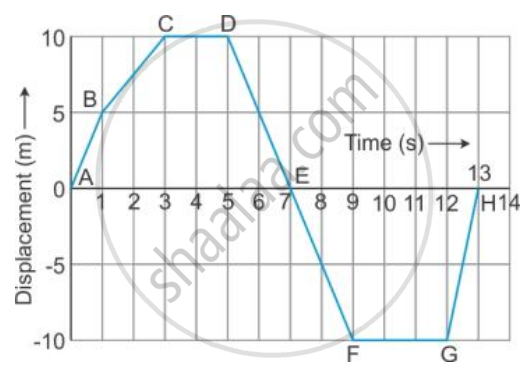
From the displacement-time graph of a cyclist given below in the Figure, find The average velocity in the first 4 s.
A train is moving with a velocity of 90 km h-1 . It is brought to stop by applying the brakes which produce a retardation of 0.5 ms-2 Find :
(i) The velocity after 10 s , and
(ii) the time taken by the train to come to rest .
A body projected vertically up with a velocity of 10 m/s reaches a height of 20 m. If it is projected with a velocity of 20 m/s, then the maximum height reached by the body is:
Derive th e equation of motion.
S = ut+ `1/2` at2,
Where the symbols have their usual meanings
Which of the following figures (Fig. 8.3) represents uniform motion of a moving object correctly?
