Advertisements
Advertisements
प्रश्न
A train takes 2 h to reach station B from station A, and then 3 h to return from station B to station A. The distance between the two stations is 200 km. Find:
The average speed,
The average velocity of the train.
Advertisements
उत्तर
Here, total distance = (200 + 200) km = 400 km
Total time taken = (2 + 3) h = 5 h
(i) Average speed = Total distance travelled/total time taken = `(400 "km")/(5 "h")` = 80 km h-1
(ii) Average velocity of the train is zero because the train stops at the same point from where it starts, i.e. the displacement is zero.
APPEARS IN
संबंधित प्रश्न
A car travels 100 km at a speed of 60 km/h and returns with a speed of 40 km/h. Calculate the average speed for the whole journey.
Give one example of a motion where an object does not change its speed but its direction of motion changes continuously.
Which of the following could not be a unit of speed?
Express the following in m s−1.
1 km h−1
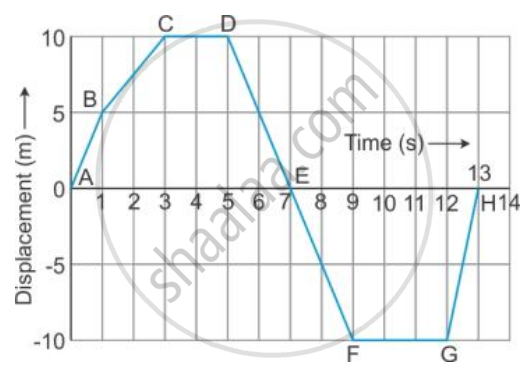
From the displacement-time graph of a cyclist given below in the Figure, find The average velocity in the first 4 s.
The velocity-time graph of a moving body is given below in Figure
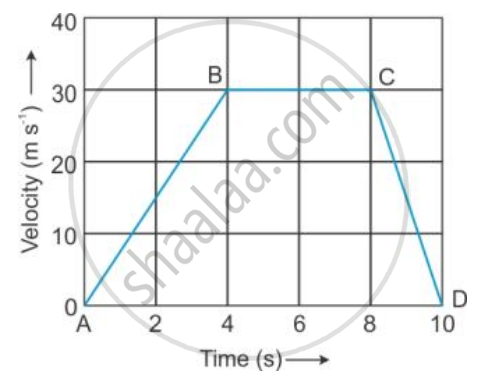
Displacement in each part AB, BC and CD.
A train travels with a speed of 60 km h-1 from station A to station B and then comes back with a speed 80 km h-1 from station B to station A. Find -
- The average speed
- The average velocity of the train.
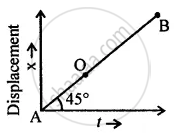
Write down the type of motion of a body along with the A – O – B of the following distance – time graph.
Which of the following figures (Fig. 8.3) represents uniform motion of a moving object correctly?
