Advertisements
Advertisements
प्रश्न
Define average velocity and give one example.
Advertisements
उत्तर
The ratio of the total distance travelled in a specified direction to the total time taken by the body to travel the distance is called average velocity.
Example: If you walk to a campsite 1 km away and then back to your starting point within 1 hour, then your average velocity will be zero because your initial and final position is the same.
APPEARS IN
संबंधित प्रश्न
Name the physical quantity which gives us an idea of how slow or fast a body is moving.
Under which condition is the magnitude of average velocity equal to average speed ?
What is the SI unit of retardation ?
The distance between Delhi and Agra is 200 km. A train travels the first 100 km at a speed of 50 km/h. How fast must the train travel the next 100 km, so as to average 70 km/h for the whole journey ?
The tip of seconds’ hand of a dock takes 60 seconds to move once on the circular dial of the clock. If the radius of the dial of the clock be 10.5 cm, calculate the speed of the tip of the seconds’ hand of the clock. `("Given" π= 22/7)`.
Which of the following statement is correct regarding velocity and speed of a moving body?
A car moving on a straight path covers a distance of 1 km due east in 100 s. What is velocity of the car?
A car is moving with a velocity 20 m s-1. The brakes are applied to retard it at a rate of 2 m s-2. What will be the velocity after 5 s of applying the brakes?
Figure shows the displacement of a body at different times .
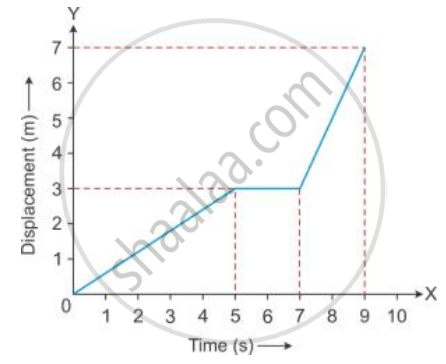
Calculate the average velocity during the time interval 5 s to 9 s ,
[Hint : From 5 s to 9 s , displacement = 7 m - 3m = 4m]
A train is moving with a velocity of 90 km h-1 . It is brought to stop by applying the brakes which produce a retardation of 0.5 ms-2 Find :
(i) The velocity after 10 s , and
(ii) the time taken by the train to come to rest .
