Advertisements
Advertisements
प्रश्न
A car is moving on a straight road with uniform acceleration. The speed of the car varies with time as follows :
Time (s) : 0 2 4 6 8 10
Speed (m/s) : 4 8 12 16 20 24
Draw the speed-time graph by choosing a convenient scale. From this graph :
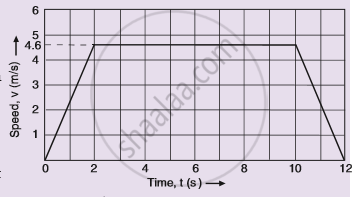
(1) Calculate the acceleration of the car.
(2) Calculate the distance travelled by the car in 10 seconds.
Advertisements
उत्तर
We have a velocity-time graph of a moving particle.

(i) We have to find the acceleration from the given graph.
Acceleration = slope of line
= `((12-4))/((4-0)) "m/s"^2 = 2 "m/s"^2`
(ii) Distance travelled by the car is given by the area enclosed by the curve.
s = `"(Sum of parallel sides)(Height)"/2`
= `((4+24)(10))/2` m
= 140 m
APPEARS IN
संबंधित प्रश्न
A tortoise moves a distance of 100 metres in 15 minutes. What is the average speed of tortoise in km/h ?
A motorcyclist starts from rest and reaches a speed of 6 m/s after travelling with uniform acceleration for 3 s. What is his acceleration ?
Which of the following can sometimes be 'zero' for a moving body?
(i) average velocity
(ii) distance travelled
(iii) average speed
(iv) displacement
Give an example of the motion of a body moving with a constant speed but with a variable velocity. Draw a diagram to represent such a motion.
Express 15 m s-1 in km h-1.
A train is moving with a velocity of 90 km h-1 . It is brought to stop by applying the brakes which produce a retardation of 0.5 ms-2 Find :
(i) The velocity after 10 s , and
(ii) the time taken by the train to come to rest .
Define average velocity and give one example.
What is the relation between distance and time when the body is moving with variable velocity?
A speeding car changes its velocity from 108 kmh−1 to 36 kmh−1 in 4 s. Calculate its deceleration in
- ms−2
- kmh−2.
Write down the type of motion of a body along with the A – O – B of the following distance – time graph.