Advertisements
Advertisements
प्रश्न
The graph given alongside shows how the speed of a car changes with time:
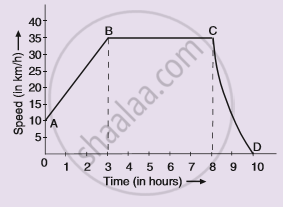
(i) What is the initial speed of the car ?
(ii) What is the maximum speed attained by the car ?
(iii) Which part of the graph shows zero acceleration ?
(iv) Which part of the graph shows varying retardation ?
(v) Find the distance travelled in first 8 hours.
Advertisements
उत्तर
(i) Initial speed of the car is 10 km/h
(ii) Maximum speed attained by the car is 35km/h
(iii) BC represents zero acceleration.
(iv) CD represents varying retardation.
(v) Distance travelled is given by the area enclosed within the curve. So,
Distance travelled = Area or trapezium + Area of rectangle
So distance travelled,
= (1/2)(8+5)(25) + (8)(10)
= 242.5 km
APPEARS IN
संबंधित प्रश्न
What does the odometer of an automobile measure?
A train starting from Railway Station attains a speed of 21 m/s in one minute. Find its acceleration.
A car is moving along a straight road at a steady speed. It travels 150 m in 5 seconds:
What is its average speed ?
Which of the following could not be a unit of speed?
The speed of a car is 72 km h-1. Express it in m s-1.
The velocity-time graph of a moving body is given below in Figure
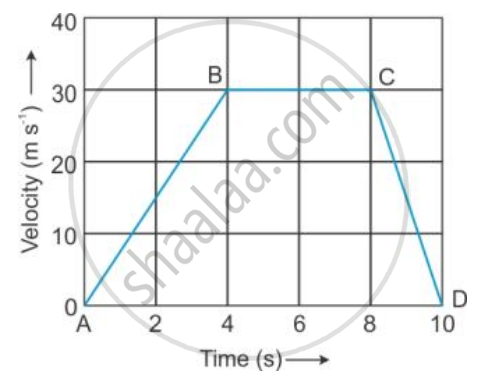
Displacement in each part AB, BC and CD.
A train is moving with a velocity of 90 km h-1 . It is brought to stop by applying the brakes which produce a retardation of 0.5 ms-2 Find :
(i) The velocity after 10 s , and
(ii) the time taken by the train to come to rest .
Define uniform velocity and give one example.
What is the relation between distance and time when the body is moving with uniform velocity?
Derive th e equation of motion.
S = ut+ `1/2` at2,
Where the symbols have their usual meanings
