Advertisements
Advertisements
प्रश्न
A train starting from Railway Station attains a speed of 21 m/s in one minute. Find its acceleration.
Advertisements
उत्तर
(b) We will find the value of uniform acceleration.
Initial velocity (u) 0 m/s
Final velocity (v) = 21 m/s
Time taken (t) = 60 s
Acceleration :
`a = (v-u)/t`
Putting the values in the above equation , we get :
`a = (21-0)/60`
= `0.35 "m/s"^2`
APPEARS IN
संबंधित प्रश्न
In addition to speed, what else should we know to predict the position of a moving body ?
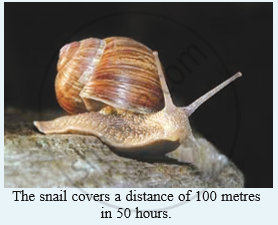
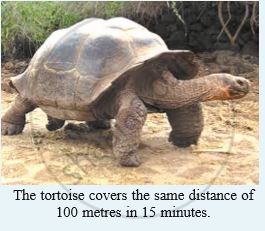
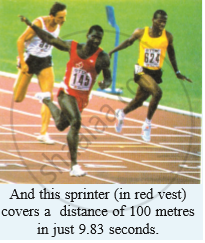
A snail covers a distance of 100 metres in 50 hours. Calculate the average speed of snail in km/h.
An aircraft travelling at 600 km/h accelerates steadily at 10 km/h per second. Taking the speed of sound as 1100 km/h at the aircraft’s altitude, how long will it take to reach the ‘sound barrier’ ?
Give an example of the motion of a body moving with a constant speed but with a variable velocity. Draw a diagram to represent such a motion.
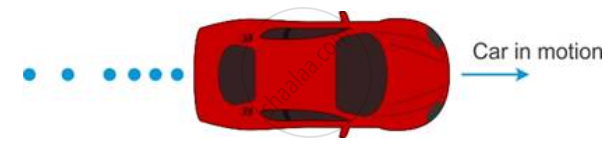
The diagram below shows the pattern of the oil on the road at a constant rate from a moving car. What information do you get from it about the motion of the car.
Express 15 m s-1 in km h-1.
A car moving on a straight path covers a distance of 1 km due east in 100 s. What is velocity of the car?
For the motion with uniform velocity , how is the distance travelled related to the time ?
A body projected vertically up with a velocity of 10 m/s reaches a height of 20 m. If it is projected with a velocity of 20 m/s, then the maximum height reached by the body is:
Derive th e equation of motion.
S = ut+ `1/2` at2,
Where the symbols have their usual meanings
