Advertisements
Advertisements
Question
A train starting from Railway Station attains a speed of 21 m/s in one minute. Find its acceleration.
Advertisements
Solution
(b) We will find the value of uniform acceleration.
Initial velocity (u) 0 m/s
Final velocity (v) = 21 m/s
Time taken (t) = 60 s
Acceleration :
`a = (v-u)/t`
Putting the values in the above equation , we get :
`a = (21-0)/60`
= `0.35 "m/s"^2`
APPEARS IN
RELATED QUESTIONS
Fill in the following blank with suitable word:
The physical quantity which gives both, the speed and direction of motion of a body is called its……………
A motorcyclist drives from place A to B with a uniform speed of 30 km h-1 and returns from place B to A with a uniform speed of 20 km h-1. Find his average speed.
The tip of seconds’ hand of a dock takes 60 seconds to move once on the circular dial of the clock. If the radius of the dial of the clock be 10.5 cm, calculate the speed of the tip of the seconds’ hand of the clock. `("Given" π= 22/7)`.
The speed of a moving object is determined to be 0.06 m/s. This speed is equal to :
Give an example of motion in which the average speed is not zero but the average velocity is zero.
The velocity-time graph of a moving body is given below in Figure
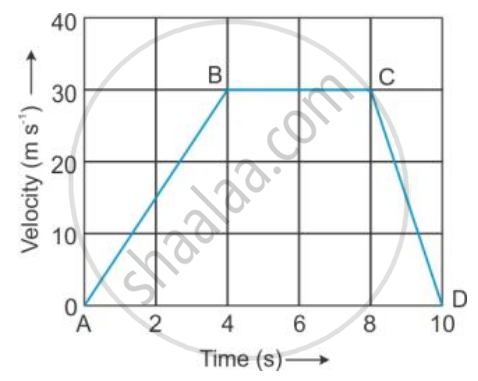
Total displacement.
Define uniform velocity and give one example.
What is the relation between distance and time when the body is moving with uniform velocity?
A speeding car changes its velocity from 108 kmh−1 to 36 kmh−1 in 4 s. Calculate its deceleration in
- ms−2
- kmh−2.
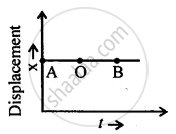
Write down the type of motion of a body along with the A – O – B of the following distance – time graph.