Advertisements
Advertisements
Question
A motorcyclist drives from place A to B with a uniform speed of 30 km h-1 and returns from place B to A with a uniform speed of 20 km h-1. Find his average speed.
Advertisements
Solution
We have to find the average velocity of the entire journey. For this, we have the following information :
Speed from A to B = (v1) = 30 m/s
Let the distance from A to B be (d).
Also, let the time taken to travel from A to B be (t1).
`"Time" = "Distance travelled"/"Speed"`
we have :
t1 = `d/30`
Speed from B to A (v2) = 20 m/s
Let the time taken to travel from B to A be (t2).
Thus, we have :
t2 = `d/20`
Total time of journey :
= t1 + t2
= `d/30 + d/20`
= `d/12`
Total distance travelled is 2d.
Therefore,
`"Average speed" = "Total distance travelled"/"Time"`
On putting the values to obtain the average speed of the motorcyclist, we get :
= `"(2d)12"/d`
= 24 km/hr
APPEARS IN
RELATED QUESTIONS
Under what condition(s) is the magnitude of average velocity of an object equal to its average speed?
In addition to speed, what else should we know to predict the position of a moving body ?
A car travels 100 km at a speed of 60 km/h and returns with a speed of 40 km/h. Calculate the average speed for the whole journey.
The graph given alongside shows how the speed of a car changes with time:
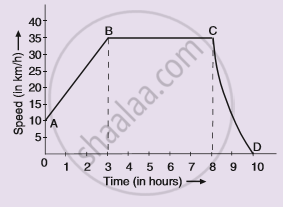
(i) What is the initial speed of the car ?
(ii) What is the maximum speed attained by the car ?
(iii) Which part of the graph shows zero acceleration ?
(iv) Which part of the graph shows varying retardation ?
(v) Find the distance travelled in first 8 hours.
Draw the shape of the velocity-time graph for a body moving with (a) Uniform velocity and (b) Uniform acceleration.
The velocity-time graph of a moving body is given below in Figure
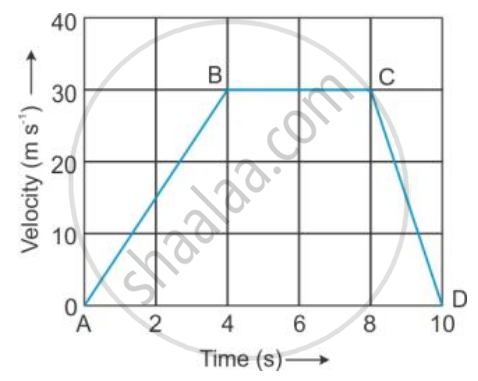
Total displacement.
A body projected vertically up with a velocity of 10 m/s reaches a height of 20 m. If it is projected with a velocity of 20 m/s, then the maximum height reached by the body is:
Write down the type of motion of a body along with the A – O – B of the following distance – time graph.
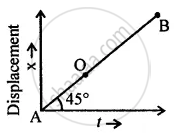
Define speed of a body.
Which of the following figures (Fig. 8.3) represents uniform motion of a moving object correctly?
