Advertisements
Advertisements
Question
How many variables are present in each equation of motion?
Advertisements
Solution
Four variables are present in each equation of motion.
APPEARS IN
RELATED QUESTIONS
Name the physical quantity obtained by dividing ‘Distance travelled’ by ‘Time taken’ to travel that distance.
Write the formula for acceleration. Give the meaning of each symbol which occurs in it.
A car is moving along a straight road at a steady speed. It travels 150 m in 5 seconds:
What is its average speed ?
Write the formula to calculate the speed of a body moving along a circular path. Give the meaning of each symbol which occurs in it.
Which of the following statement is correct regarding velocity and speed of a moving body?
One of the following is not a vector quantity. This one is :
The speed of a car is 72 km h-1. Express it in m s-1.
A car is moving in a straight line with speed 18 km h-1. It is stopped in 5 s by applying the brakes. Find:
- the speed of car in m s-1
- the retardation and
- the speed of car after 2 s of applying the brakes.
The velocity-time graph of a moving body is given below in Figure
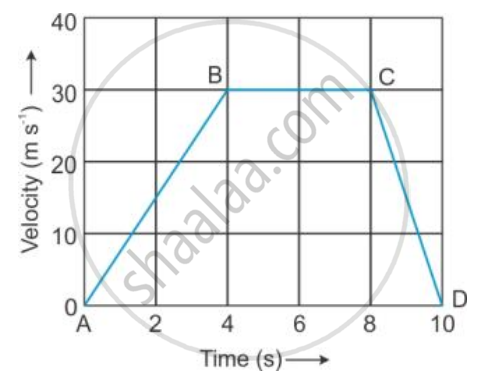
The acceleration in parts AB, BC and CD.
A motorcyclist drives from A to B with a uniform speed of 30 km h–1 and returns back with a speed of 20 km h–1. Find its average speed.
