Advertisements
Advertisements
Question
A train travels the first 15 km at a uniform speed of 30 km/h; the next 75 km at a uniform speed of 50 km/h; and the last 10 km at a uniform speed of 20 km/h. Calculate the average speed for the entire train journey.
Advertisements
Solution
(i) In the first case, the train travels at a speed of 30 km/h for a distance of 15 km.
We can find the time as :
`"Time" = "Distance travelled"/"Speed"`
S0,
t1 = `15/30` hr
= 0.5 hr
(ii) In the second case, the train travels at a speed of 50 km/h for a distance of 75 km.
We can find the time as :
`"Time" = "Distance travelled"/"Speed"`
So ,
t2 = `75/50` hr
= 1.5 hr
(iii) In the third case, the train travels at a speed of 20 km/h for a distance of 10 km.
We can find the time as :
`"Time" = "Distance travelled"/"Speed"`
So ,
t3 = `10/20` hr
= 0.5 hr
Total distance covered :
= (15 + 75 + 10) km
= 100 km
Total time taken = (0.5 + 1.5 + 0.5) km
= 2.5
Therefore , Average speed = `"Total distance travelled"/"Time"`
Now , put the values to get the average speed .
= `100/2.5`
= 40 km/hr
APPEARS IN
RELATED QUESTIONS
The graph given alongside shows how the speed of a car changes with time:
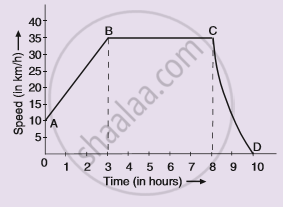
(i) What is the initial speed of the car ?
(ii) What is the maximum speed attained by the car ?
(iii) Which part of the graph shows zero acceleration ?
(iv) Which part of the graph shows varying retardation ?
(v) Find the distance travelled in first 8 hours.
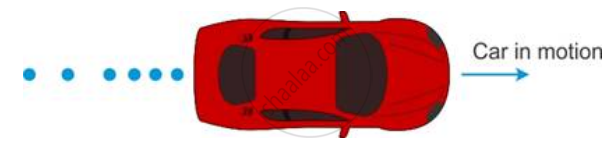
The diagram below shows the pattern of the oil on the road at a constant rate from a moving car. What information do you get from it about the motion of the car.
A car moving on a straight path covers a distance of 1 km due east in 100 s. What is velocity of the car?
Figure shows the displacement of a body at different times .
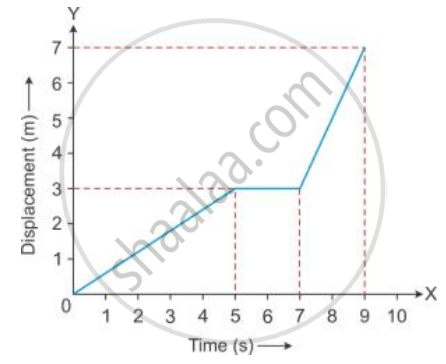
Calculate the average velocity during the time interval 5 s to 9 s ,
[Hint : From 5 s to 9 s , displacement = 7 m - 3m = 4m]
A train travels with a speed of 60 km h-1 from station A to station B and then comes back with a speed 80 km h-1 from station B to station A. Find -
- The average speed
- The average velocity of the train.
What is the relation between distance and time when the body is moving with variable velocity?
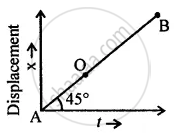
Write down the type of motion of a body along with the A – O – B of the following distance – time graph.
Define speed of a body.
Derive th e equation of motion.
S = ut+ `1/2` at2,
Where the symbols have their usual meanings
Distinguish between speed and velocity.
